On Oct. 14, the City received a letter from the Sugar House Chamber & Community Alliance, the community group that started the process, asking to stop the Special Assessment Area (SAA) process for Sugar House.
Because the City received the request before the Oct. 19 deadline for property owners to submit protests, the City has stopped accepting protests. At this time, the SAA process will not be going forward. Property owners will be notified about this update.
What is a Special Assessment Area?
A Special Assessment Area (SAA) is a financing tool that allows property owners in a defined area to collectively pay for improvements, operations and maintenance, or economic promotion that benefits the area.
The Proposed Sugar House SAA
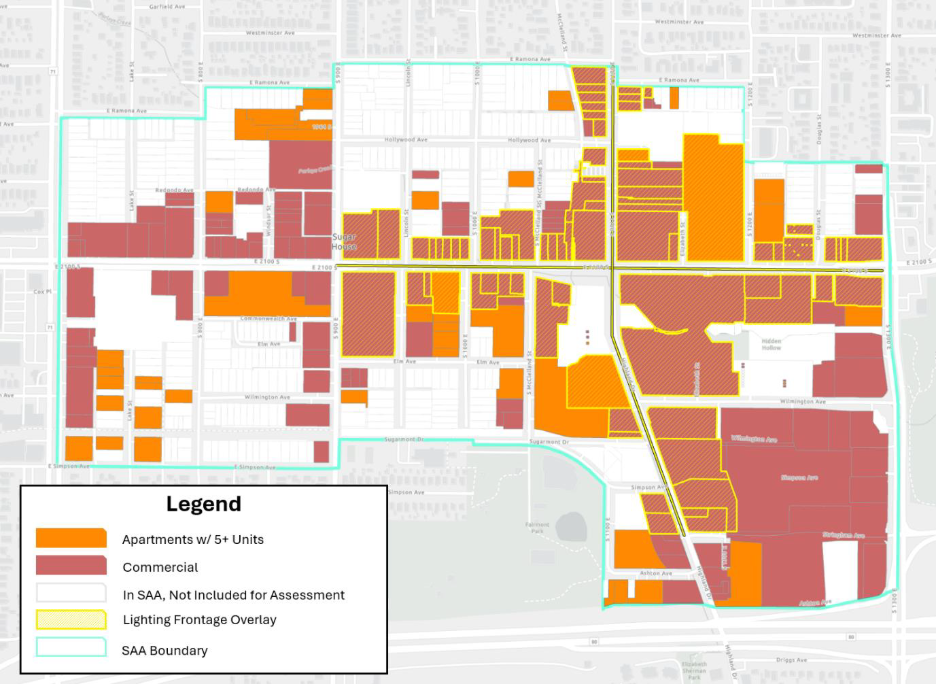
In 2021, the Sugar House Chamber & Community Alliance (SHC) requested the creation of a special assessment area for the Sugar House Area. The city’s Department of Economic Development developed three assessment scenarios, all with the same boundary.
The SHC reviewed each and preferred Scenario 3 as the most sufficient to operate the area while remaining acceptable to property owners. The proposed SAA is projected to raise $1,697,640 over the area’s proposed three-year period.
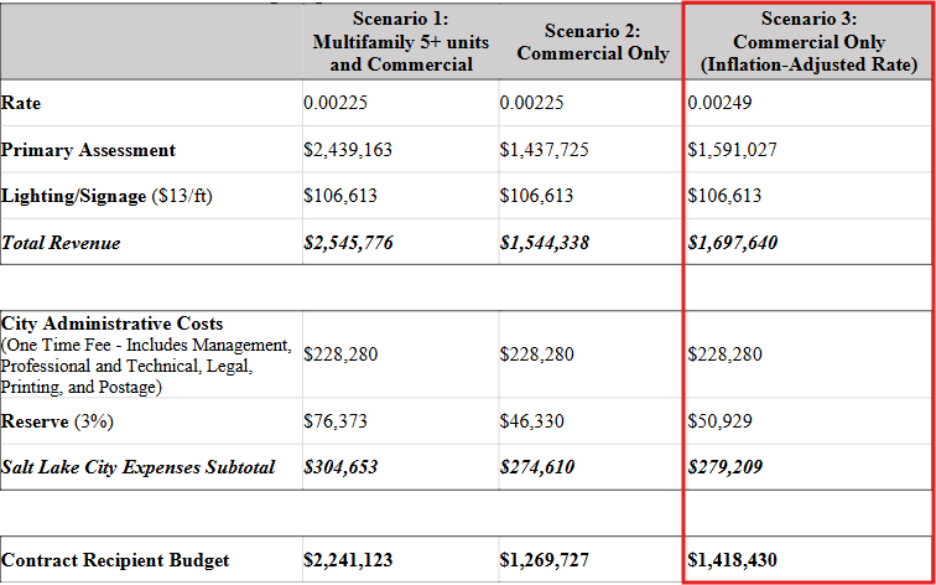
The proposal also includes a second assessment that would apply to properties with frontage on certain streets for specialty lighting and signage. $13/linear foot along 2100 South, Highland Drive, and 1100 East for year-round specialty lighting. If future road construction disrupts lighting, funds may also support temporary business signage.
What else should I know?
- If owners representing 40% or more of the total assessed value object, the SAA cannot be created.
- Residential, ecclesiastical, government-owned properties, and any property valued under $20,000 are exempt (unless the owner volunteers to participate).
- No more than 30% of funds can be spent on administrative costs.
- Properties left out at the start cannot be added later without owner consent.
- Multifamily housing with five or more units is eligible to be assessed and included in an SAA. However, it was decided not to include these properties due to sensitivity to housing costs. They could be considered in future assessment authorizations after the initial three-year term.
Timeline
Creating an SAA is governed by Utah’s Assessment Area Act and involves multiple Council actions, public notices, and hearings. Below are the key milestones. Read the full detailed timeline here.
| Council Briefing | May 28, 2026 |
| Council Vote on the on the Resolution of Intent to Designate the assessment area. | June 9, 2026 Council approved a resolution declaring intent to create the SHBD-27. This does not create the SAA but starts the process. |
| Protest Hearing | August 18, 2026 The Council held a protest hearing, during which several people spoke. It also starts a 60-day window during which property owners can send in written protests. If property owners holding 40% or more of the total valuation in the SAA protest its creation, the SAA cannot be created, and the process ends. |
| Retraction | October 14, 2026 The Sugar House Chamber & Community Alliance has retracted its request to explore a Special Assessment Area (SAA) and asked the city to stop the process. Because the City received the request before the Oct. 19 deadline for property owners to submit protests, the City has stopped accepting protests. The SAA process has now been discontinued. Read the Retraction Letter. |
Meeting Recap
Aug. 18: Protest Hearing
The Council held a protest hearing during which several people spoke. Most commenters objected to the assessment, noting the current struggles facing businesses in the area, including inflation, construction, and the loss of parking spaces in front of businesses.
The hearing also started a 60-day window during which property owners can send in written protests. If property owners holding 40% or more of the total valuation in the SAA protest its creation, the SAA cannot be created, and the process ends.
June 9: Council Approves Resolution of Intention
The Council approved a resolution of intention to designate an assessment area for economic promotion activities in Sugar House over a three-year period. This resolution will not create the SAA, only declares the City’s intention to create one.
May 28: Briefing
Economic Development staff presented the Council with an overview of the proposal. They discussed similarities to the Downtown SAA and future possibility of including multifamily housing to SAAs.
Resources
- Read the Proposal
- Read the Sugar House Chamber & Community Alliance Retraction Letter
- Read the Latest Council Staff Report
- Learn More about SAAs
- Read the State Code
- View the Timeline
Explore more: