SLC Public Lands Confirmed Collaborative Efforts Policy
Purpose Statement:
This policy identifies how Public Lands works with the community and organizations and the criteria for various collaboration types.
Introduction
Introduction:
Salt Lake City’s Public Lands Department (Public Lands) recognizes the importance of working with the community and other City departments to make our public parks, trails, and natural lands better for everyone. This policy aims to facilitate meaningful collaborations with external organizations, all guided by the principles of the Reimagine Nature Master Plan. It will also help establish a shared understanding of constraints and opportunities allowed within each Confirmed Collaborative Efforts (CCE) or collaborative effort. By mutually agreeing on what is permissible and aligning our objectives, we aim to minimize direct oversight from Public Lands. These guidelines help optimize resources and ensure that our combined efforts generate the most significant positive impact on the community and Salt Lake City’s public lands. We aim to continuously build relationships that reflect the richness of perspectives within our community. Salt Lake City Public Lands is committed to fostering diverse, equitable, and inclusive community relationships that will extend our ability to reach the goals outlined in the Reimagine Nature Master Plan. Guided by the belief that collaboration thrives when all voices—regardless of race, ethnicity, gender, sexual orientation, age, disability, or religion—are heard and respected, all community members can submit proposals to participate in the collective stewardship of our parks, trails, and open spaces. Public Lands supports approved efforts with various resources, from equipment to expertise, to bolster the impact.
Types of Confirmed Community Collaborations
Types of Confirmed Community Collaborations:
Considering the master plan guidance, this document explains the criteria, processes, and tiers that Public Lands uses to evaluate and establish strategically valuable CCEs for the department.
*Note: Entering into a collaborative agreement with Public Lands does not grant Recognized Community Organization (RCO) status, a separate process outlined on Salt Lake City’s website. While becoming an RCO offers benefits like city networking and enhanced communication, it’s not a requirement for working with Public Lands.
Stewardship and Programming: Public Lands may work with organizations that wish to act as stewards of our spaces, whether that be through volunteer activities or other relevant programming. This category may include “Friends of” groups that advocate or fundraise for specific Public Lands’ properties.
Community Events: Public Lands may work with external organizations that wish to host community events in Public Lands’ spaces by providing financial and logistical support to obtain event permits and on-site resources such as waste and recycling, restrooms, and security.
Community Engagement: Public Lands may work with organizations that allow the department to gather public input on the department’s projects and initiatives. These CCE’s may have a defined start and end point or be ongoing.
Park Rangers: The Park Rangers may work with organizations to create deeper connections and enjoyment with our parks and open spaces, particularly around education, customer service, and public safety.
Confirmed Community Collaboration Establishment Process
Confirmed Community Collaboration Establishment Process
Confirmed Community Collaboration Establishment Process
Most CCEs will be guided by a document or email that identifies the specific attributes of the work roles, responsibilities, opportunities, and constraints. For more complex collaborations, work agreements such as MOUs, sweat equity agreements, operating agreements, or contracts may be required.
- Submission of CCE Interest Form:
a. This initial form, which can be initiated by either the outside organization or Public Lands staff, gathers essential information to help our Internal CCE Committee evaluate potential collaborations. b. Public Lands will provide an initial response within 10 business days of initial application.
c. Based on the CCE category, a more detailed questionnaire may be required. - Internal Review:
a. The Public Lands staff assesses the submission against pre-established criteria. Meetings are held as needed.
b. Each CCE may require an additional level of review approval, to be determined in the early stages of the application process. - Notification:
a. The initiator of the interest form will be informed of the Department’s decision to either pursue or reject the CCE.
b. Public Lands will provide notification within 20 business days of completion of all applicable documents. - CCE Formalization:
a. The nature of each CCE dictates its level of formalization.
b. Simple collaborations may involve verbal agreements
Reimagine Nature Master Plan Guiding Values and Strategies
Reimagine Nature Master Plan Guiding Values and Strategies
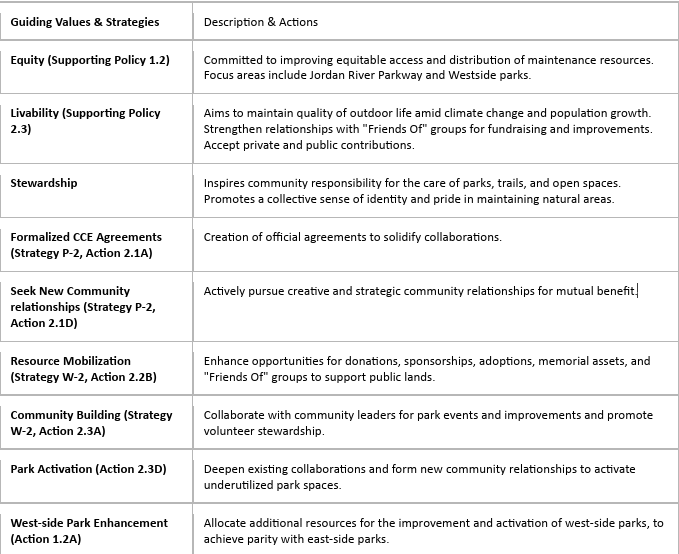
The Reimagine Nature Master Plan offers targeted purposes for cultivating collaborative relationships and securing sponsorships. Key recommendations encompass a range of CCE strategies, though they are not limited to the following highlights:
Public Lands Role in Community Collaborative Efforts
Public Lands Role in Community Collaborative Efforts:
Public Lands resources are based on availability of supplies, staff capacity, and alignment with Masterplan goals. While the level and type of support provided will vary based on the unique needs and scope of each organization or event, the bullet points below outline some keyways we may be able to assist in community collaborations.
The options outlined below are provided to CCEs based on availability of resources.
• Staff Expertise: Provide expert guidance and staff coordination to help CCEs accomplish their goals.
• Networking: Connect CCEs to relevant people and organizations to enhance their initiatives.
• Community Outreach: Assist in publicizing CCEs’ opportunities and events to garner more community participation.
• Volunteer Tools: Supply essential tools for volunteers during service events to ensure effective work. The Public Lands Volunteer Program has a tool inventory that includes wheelbarrows, shovels, rakes, brooms, pruners, grabbers, buckets, garbage bags and other items to assist in volunteer efforts. Availability of these supplies will vary depending on other event needs.
• Waste Management: Offer dumpster and bin delivery and pick-up services to maintain cleanliness in public spaces.
• On-Site Coordination: Provide on-site staff for event coordination and facilitation, ensuring smooth execution.
• External Volunteers: Facilitate CCEs with outside volunteer groups to amplify manpower and reach.
• Funding Opportunities: Guide CCEs to potential funding sources available through city programs.
• Community Building: Create opportunities for CCEs to socially connect with other community members through beneficial projects.
• Recognition: To the extend agreed upon by both parties share CCEs’ efforts so that they can be recognized and celebrated by both the city and the community at large.
CCE Considerations
CCE Considerations:
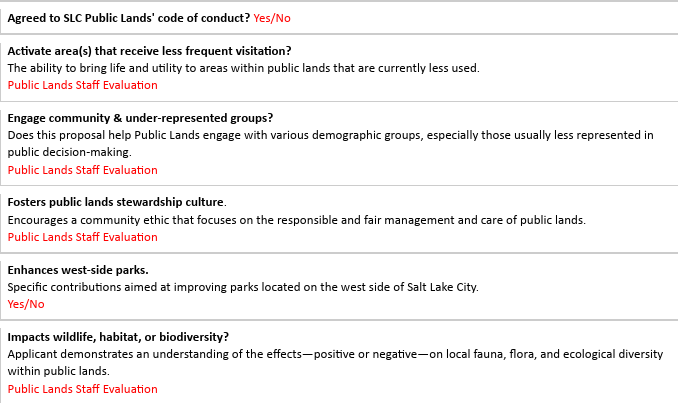
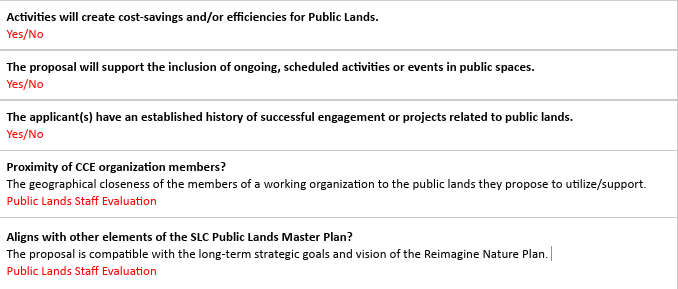
Public Lands staff use the considerations below to determine if a proposed CCE aligns with organizational goals, resources, and strategy. Each CCE proposal may be subject to additional review to ensure the goals of each party are met.
Supporting Documentation
Supporting Documentation:
• Donation Policy and Information
• Friends of Group Information (Coming soon)
• SLC Public Lands Civility Policy (Coming Soon)
Stewardship and Programming Confirmed Community Collaborations
Stewardship and Programming Confirmed Community Collaborations:
Evaluation criteria for stewardship and programming CCEs with Public Lands uses specific considerations to assess the strategic value of potential stewardship or programming work. This document outlines different types of CCEs.
1: Community Groups
• Description: Community groups collaborate with SLC Public Lands to steward and activate specific parks. These groups concentrate their volunteer efforts in a localized area, usually within their neighborhood.
• Responsibilities: CCEs commit to a predetermined number of yearly stewardship or programming events.
• Examples: Friends of Allen Park and Friends of Fairmont Park are affiliated with community councils but not formally incorporated.
• Scope: Limited to a specific site or park.
2: Program and/or Project Non-profit CCE
• Description: Organizations with missions closely aligning with SLC Public Lands’ objectives. These CCEs have a track record of event leadership, programming, or fundraising in conjunction with Public Lands.
• Responsibilities: Clearly defined scope of work related to specific public lands, programs, or initiatives.
• Legal Requirements: Must be a registered legal entity (e.g., 501(c)(3)).
• Examples: Local Non-profits, Sage Land Cooperative, Friends of SLC Cemetery, and Tree Utah.
• Memorandum of Understanding (MOU): Public Lands may pursue an MOU with CCEs at this tier.
• Scope: Not limited to a specific site or park.
3: Operating Agreement
• Description: Organizations entering into an operating agreement to manage significant aspects of a property’s maintenance, operations, or programming.
• Responsibilities: More autonomy in construction, operation, maintenance, and programming projects.
• Legal Requirements: Must be a registered legal entity (e.g., 501(c)(3)).
• Examples: Gilgal Gardens, which oversees all operations of its site.
• Scope: Aligns closely with the broader mission, vision, and values of SLC Public Lands.
One-Time Stewardship or Volunteer Projects
Public Lands may collaborate with volunteer groups for one-off projects outside the CCE types. However, preference will be given to Tier 1, 2, or 3 CCEs scheduling or resource conflicts.
“Friends of” Groups Explained
The term “Friends of” is not a standalone category. Depending on the specifics of their CCE with the City, such groups can fall under any of the above types. Some “Friends of” groups may exist in Salt Lake City without any formal CCE arrangement with Public Lands.
Community Events CCEs and Sponsorships
Community Events CCEs and Sponsorships:
Understanding the importance of community engagement, Public Lands aims to support neighborhood and community events.
Equipment and Support
In CCE agreements, Public Lands Events Division may offer various equipment including, but not limited to:
• Trailer stage
• Sound system
• Generators
• Canopies
• Tables
• Chairs
• Coolers
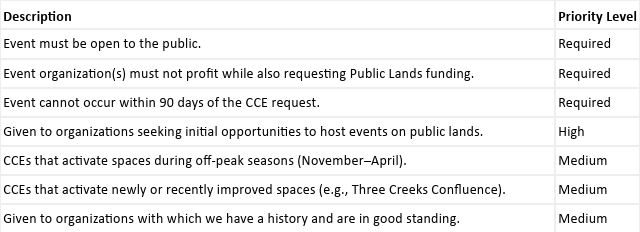
Evaluation Criteria for Event CCEs and Sponsorships
Public Lands considers the following criteria to assess the strategic value of a potential event CCE:
Alternative Funding: ACE Program
Event organizers may also explore funding through the ACE Program, administered by the Mayor’s Office. Organizers are encouraged to pursue ACE funding if a CCE with Public Lands is not feasible. Learn more about ACE funding here.
Community Engagement CCEs
Community Engagement CCEs:
In alignment with our commitment to community engagement, these CCEs help extend our reach, build capacity, and foster a deeper understanding of community needs.
Types of Community Engagement CCEs
• Groups that Extend Reach and Activate Parks
• Groups that can extend our community reach through information sharing and diverse programming that activates our parks. Examples: Schools, Park, BioBlitz
• Groups that Build Capacity: We value CCEs that can contribute supplies or assist in volunteer recruitment, enhancing our operational capacity. Examples: Interns from schools, University of Utah students helping with engagement
• Groups that Increase Access to Knowledge and Experts: CCEs with specialized expertise can guide us in ecological restoration, environmental design, and community accessibility. Examples: Advisory Committees for projects, Jordan River Commission, Tracy Aviary Priority is given to CCEs that can connect us with community leaders and organizations, facilitating better community engagement and trust-building.
Park Rangers CCEs
Park Rangers CCEs:
CCEs with Public Lands fit into one or more categories: open spaces, particularly around public safety, customer service, and education.
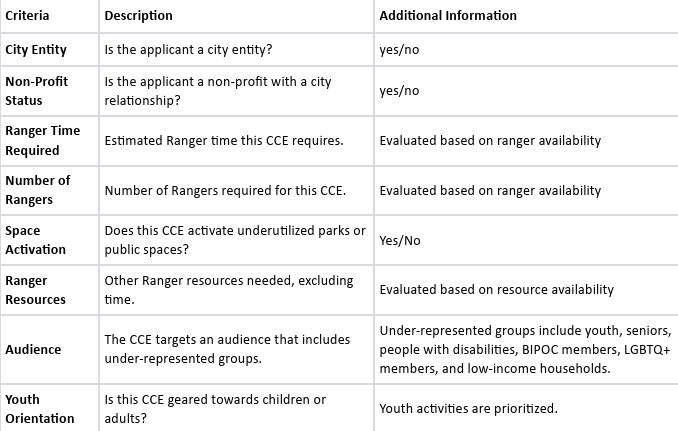
The Salt Lake City Park Rangers actively engage in CCEs to increase program capacity and support various city divisions, organizations, and groups. Park Ranger CCEs also help connect groups to Public Lands’ resources and enhance visitors’ knowledge and experience in parks and natural areas. While some criteria overlap with those in other sections of this document, specific factors are crucial when evaluating a potential CCE with Park Rangers.
Types of Park Rangers CCEs
• City Entity CCEs: Involving city entities, such as other departments or divisions within Salt Lake City.
• Non-Profit Groups: Non-profit organizations that have an existing relationship with the city.
• Resource-Oriented Groups: Groups that require specific Ranger resources, other than time.
• Community Activation Groups: CCE aimed at activating underutilized parks or public spaces.
• Youth-Oriented Groups: CCE specifically aimed at serving children rather than adults.
Evaluation Considerations for Park Rangers CCEs