Livable Streets is Salt Lake City’s program for slowing down traffic on neighborhood streets. We work with residents one zone at a time to make streets safer and more comfortable for everyone who lives, walks, bikes, and drives there.
Report a traffic safety issue
Seeing speeding or other safety problems on your street? Tell us with the Report Traffic Safety Issues form. It’s open all year for every neighborhood, and we use what you share when we plan your zone. You can also email [email protected] or leave a voicemail at 801-535-6412.
How it works
We split the city into 113 zones and ranked them by crash history, traffic speeds, and neighborhood needs. With about $2 million a year, we work through 4 to 5 zones each year, in order. Each zone goes through seven steps.
- Report traffic safety issues. Residents tell us where they see speeding and other safety problems.
- What we heard. We sum up what residents told us.
- Draft plan. We use what we heard and what we see on your streets to draft a plan. You can review it and comment.
- Feedback summary. We share what people said about the draft plan.
- Final plan. We update the plan based on your feedback and share the final version.
- Construction. We build the improvements.
- Moving forward. We keep collecting traffic data and listening to residents to see how the changes are working.
When your zone is active, its shapeSLC page is where you’ll find events, draft plans, and ways to comment.
Want the details behind the program? Our 2022 program report explains how we created the 113 zones, how we ranked them, and the order we’ll work through them. Read the Livable Streets program report (PDF).
Where each zone stands
Find your zone on the map, then check its status below. Open a zone to see its details. For photos of each type of change, visit the traffic calming toolkit. If the map is hard to use, email or call us with your address and we’ll tell you your zone.
In planning now
Zones 17 to 21
Planning is underway. Visit each zone’s shapeSLC page for events, draft plans, and ways to comment.
Construction coming soon
Zones 12 to 16
Plans for these zones are final. We expect to build them in winter 2026–27 or spring 2027.
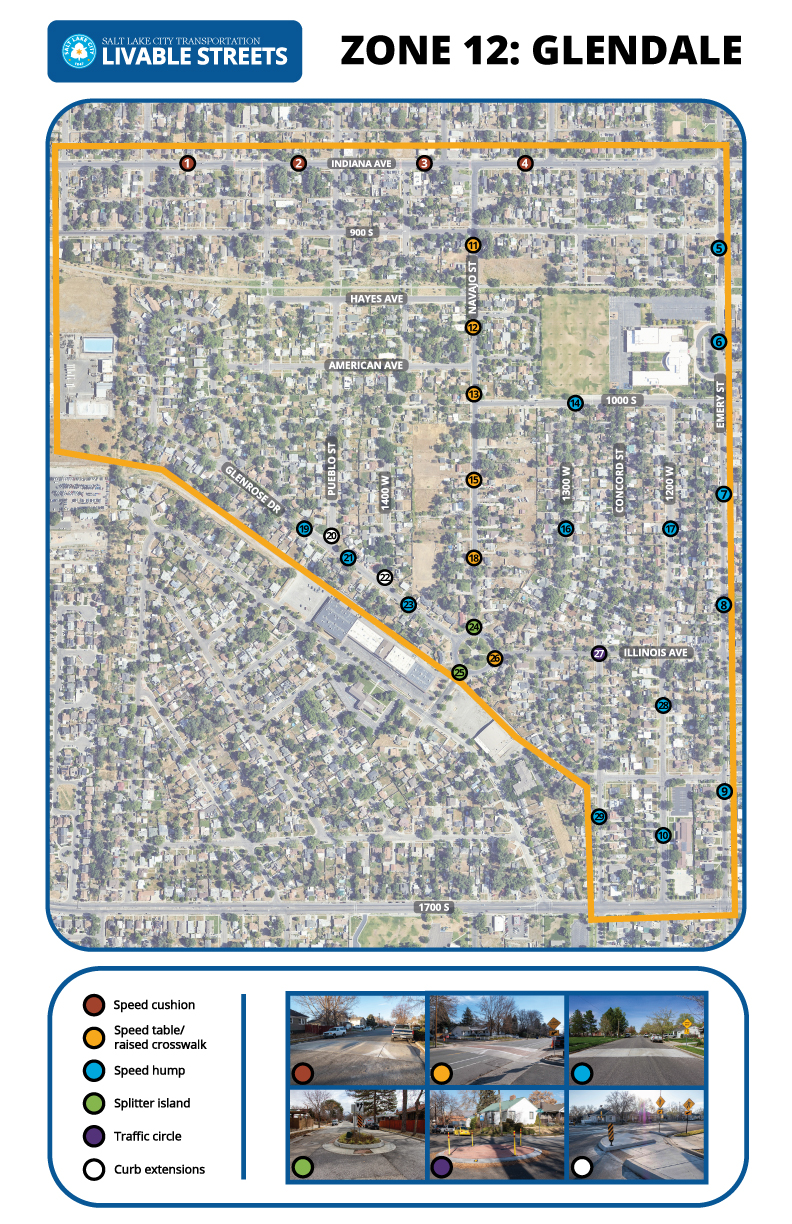
Zone 12: Glendale
What’s planned
- 5 speed humps on Emery Street, Indiana Avenue to 1700 South
- 3 speed humps on 1200 West, 1000 South to 1700 South
- 3 speed humps on Glenrose Drive
- 1 speed hump each on 1300 West and Concord Street
- 6 speed tables or raised crosswalks on Navajo Street
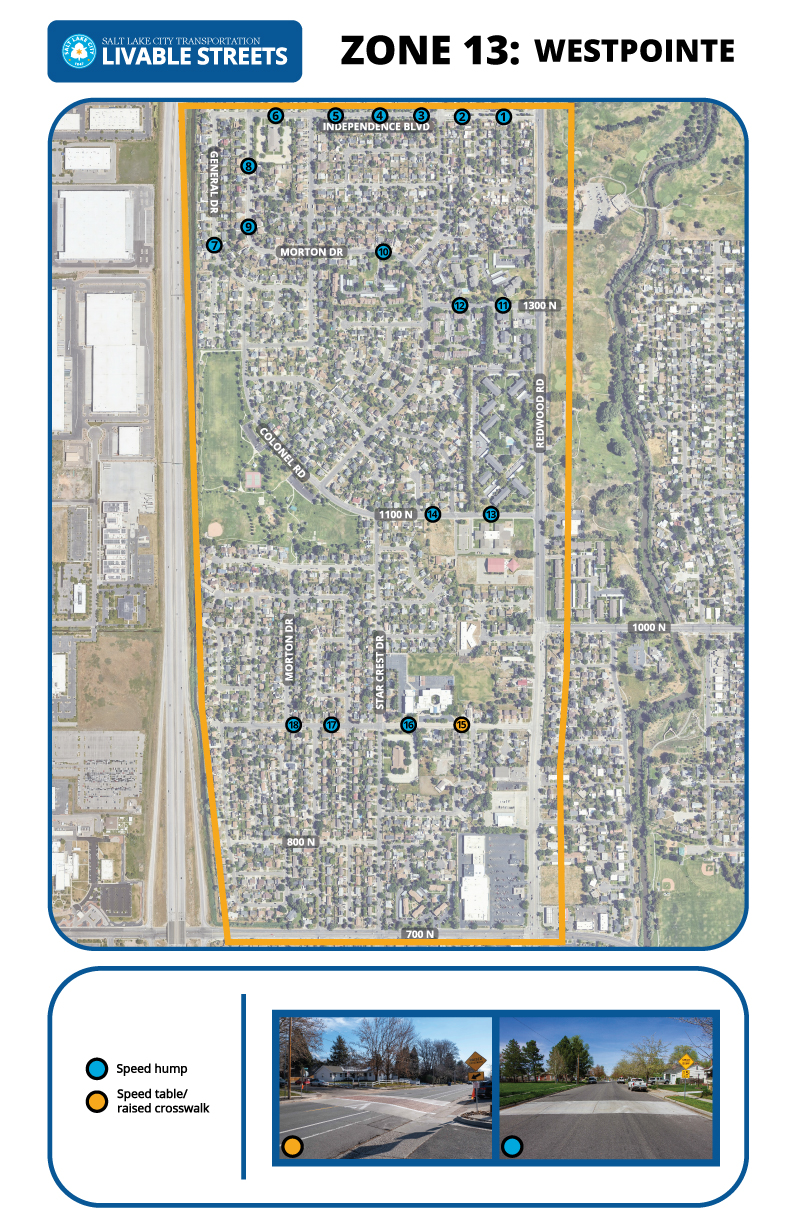
Zone 13: Westpointe
What’s planned
- 3 speed humps and a raised crosswalk on 900 North
- 6 speed humps on Independence Boulevard
- 3 speed humps on Morton Drive
- 2 speed humps each on 1100 North and 1300 North
- 1 speed hump on General Drive
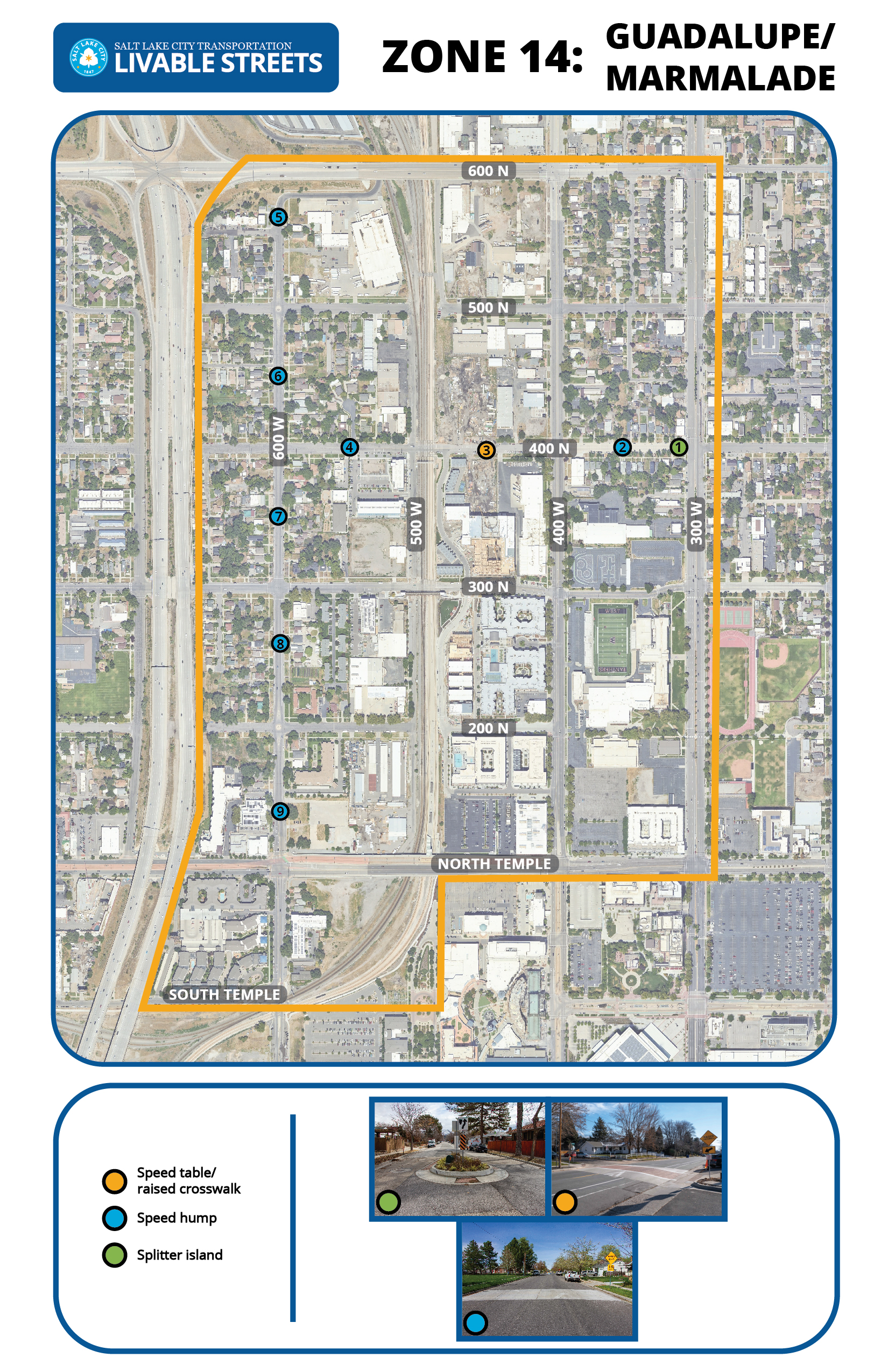
Zone 14: Guadalupe/Marmalade
What’s planned
- 5 speed humps on 600 West
- 2 speed humps and a raised crosswalk on 400 North
- A median island on 400 North at 300 West
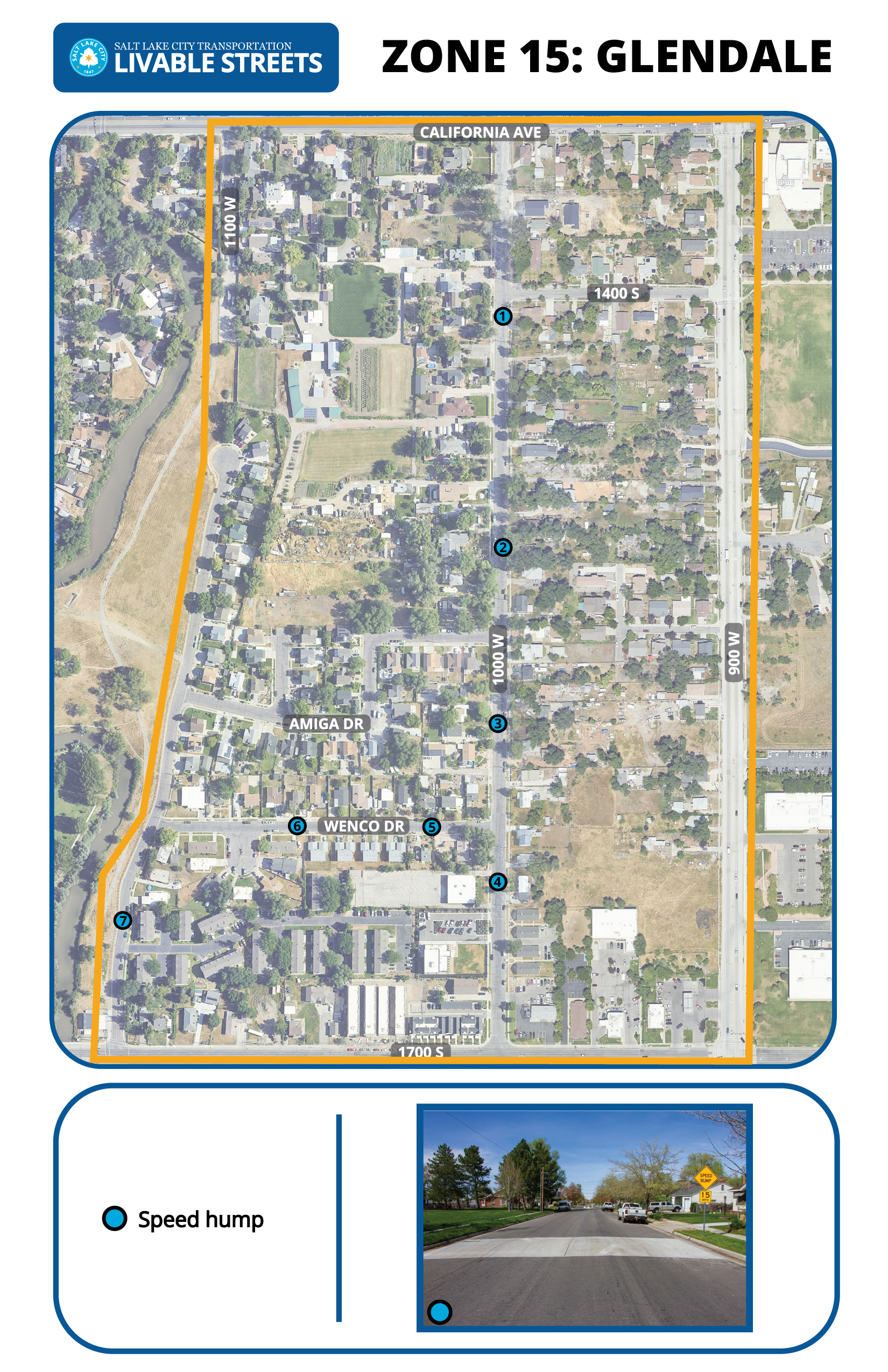
Zone 15: Glendale
What’s planned
- 4 speed humps on 1000 West
- 2 speed humps on Wenco Drive
- 1 speed hump on 1100 West, just north of 1700 South
Zone 16: Fairpark
What’s planned
- Speed humps on 500 North (3), 400 North (2), and 800 West (2)
- Intersection improvements at 400 North and 800 West, and at 500 North and 800 West
- Median islands at 400 North and 900 West, 800 West and 300 North, and 400 North and 700 West

Complete
Zones 1 to 9
Traffic calming is built in these zones, with a few projects still to come. West Temple from 1300 South to 1700 South and the intersection of 700 South and 400 East are approved and will be built once the contractor schedules the work. A raised crosswalk on 500 East near 450 South, in front of Smith’s, is being reviewed by the Utah Department of Transportation (UDOT), as Senate Bill 242 now requires for some City streets.
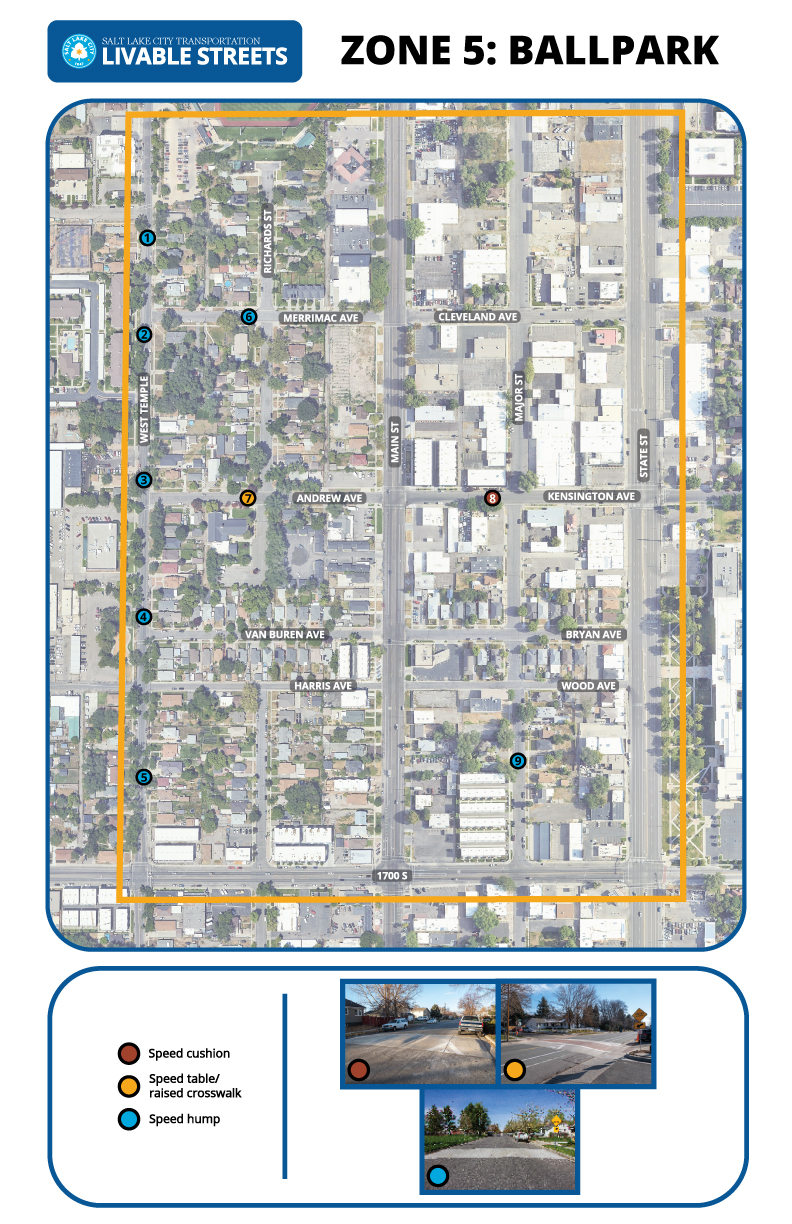
Zone 5: Ballpark
What’s built
- 5 speed humps on West Temple
- Speed humps on Merrimac Avenue, West Temple to Richards Street
- Speed humps on Major Street, south of Wood Avenue
- A raised crosswalk on Andrew Avenue, West Temple to Richards Street
- A speed cushion on Kensington Avenue, Main Street to Major Street
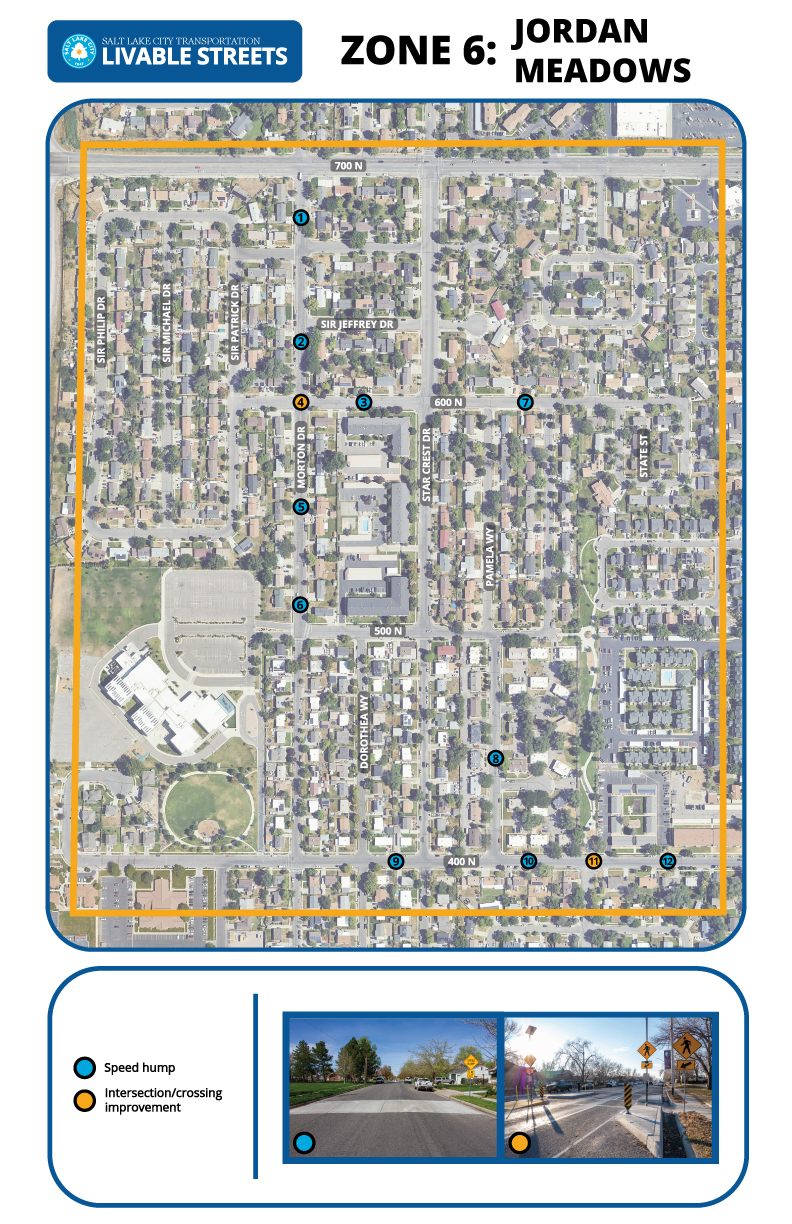
Zone 6: Jordan Meadows
What’s built
- 4 speed humps on Morton Drive, 500 North to 700 North
- 2 speed humps on 600 North near Starcrest Drive
- 1 speed hump on Pamela Way, 400 North to 500 North
- 3 speed humps on 400 North, Redwood Road to Dorothea Way
- Crossing improvements on 400 North near the park and at 600 North and Morton Drive
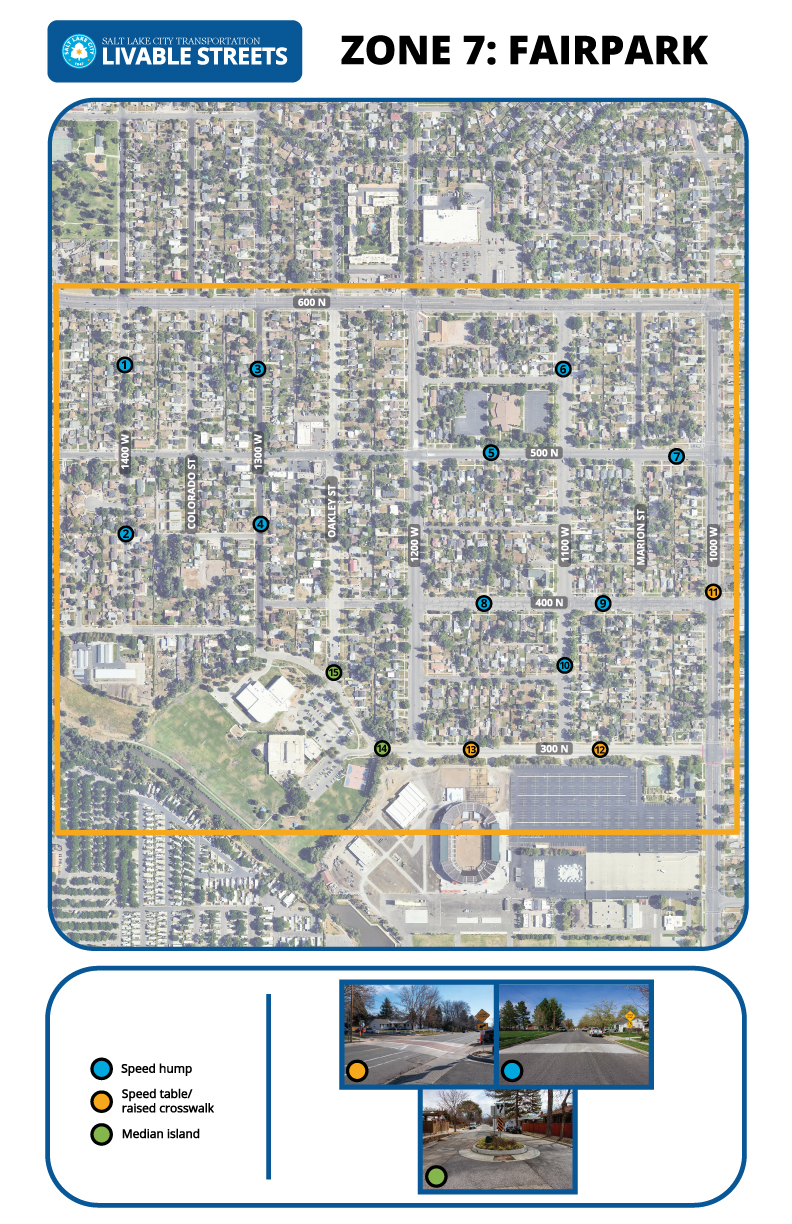
Zone 7: Fairpark
What’s built
- 2 speed humps each on 1400 West, 1300 West, 1100 West, 500 North, and 400 North
- 2 raised crosswalks or speed tables on 300 North
- A raised crosswalk at 1000 West and 400 North
- Intersection improvements and median islands near the Northwest Recreation Center
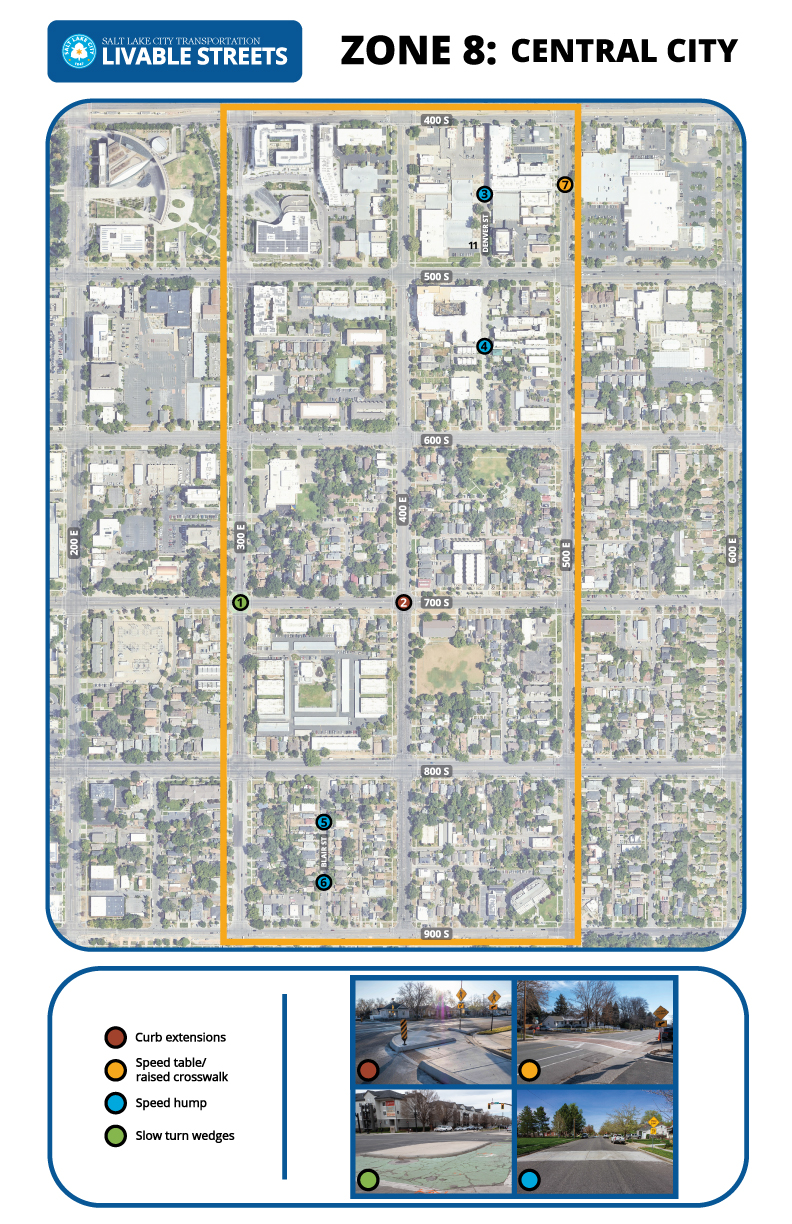
Zone 8: Central City
What’s built
- 2 speed humps on Blair Street, 800 South to 900 South
- 2 speed humps on Denver Street, 400 South to 600 South
- Slow turn wedges, which make drivers turn more slowly, at 300 East and 700 South
- Curb extensions at 400 East and 700 South (coming soon)
- A raised crosswalk on 500 East near 450 South (under UDOT review)
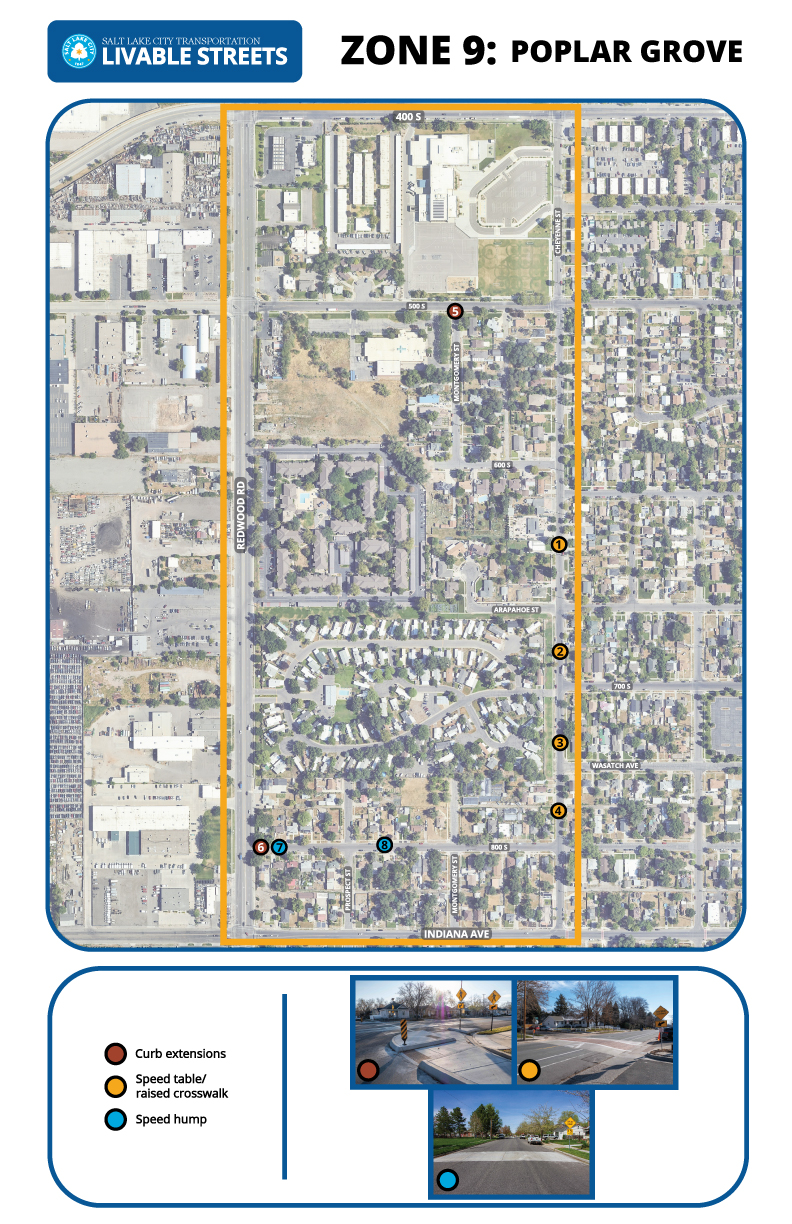
Zone 9: Poplar Grove
What’s built
- 4 speed tables on Cheyenne Street, 500 South to Indiana Avenue
- 2 speed humps on 800 South, Cheyenne Street to Redwood Road
- Curb extensions at Montgomery Street and 500 South, near the elementary school
- Curb extensions at 800 South and Redwood Road
On hold
Zones 10 and 11
These zones are mostly downtown. Several big downtown projects are in the works, so we’re waiting to plan these zones around them.
Coming later
Zones 22 to 113
We’ll work through the rest of the zones in order. If your zone isn’t active yet, you can still report traffic safety issues on your street.
Results
We count traffic speeds and volumes on some streets in each zone before and after construction. We’ll post the results for completed zones here as the counts are finished.
Completed projects
Frequently asked questions
When will my street get traffic calming?
We work through zones in the order set in the program report (PDF). We finish about 4 to 5 zones a year, depending on how big each zone is and how much work it needs. Check where each zone stands to see where yours is.
How were the zones ranked?
We looked at crashes, speeds, and who lives in each zone. That included the number of households and how many households live in poverty or don’t have a car, based on 2016 census survey data. The goal is to invest first where the need is greatest.
Does my street qualify?
Your street may qualify if it:
- Has a speed limit of 30 mph or less
- Is owned and maintained by Salt Lake City
- Has three or fewer travel lanes
- Isn’t on a university campus or inside a park
- Isn’t already set for improvements through another funded project
- Is next to homes or other residential buildings
Why plan by zone instead of street by street?
We get a lot of requests for traffic calming and reports of safety problems. Fixing one street at a time led to scattered changes that didn’t make whole neighborhoods calmer. Planning a whole zone at once lets us see the bigger picture, fit our plans with the City’s other transportation plans, and choose changes that really slow traffic down.
Why does speed matter so much?
A few miles per hour can decide how badly someone is hurt in a crash. A AAA Foundation for Traffic Safety study found that a person walking who is hit at 23 mph has about a 1 in 4 chance of being severely injured. At 31 mph, the chance is 1 in 2.
In 2022, Salt Lake City lowered the speed limit on local streets from 25 mph to 20 mph. That covers about 420 miles, or 70% of City streets. Signs alone don’t slow everyone down, so traffic calming uses street design to help drivers go slower. Learn about the 20 mph speed limit.
In 2023, Salt Lake City joined Vision Zero, with a goal of no traffic deaths or serious injuries by 2035. Vision Zero accepts that people make mistakes, so streets should be designed to keep those mistakes from costing lives. Learn about Vision Zero in Salt Lake City.
Does traffic calming work?
We count speeds and traffic before and after construction and post the numbers in the results section. You can also read a 2019 University of Utah study, Effectiveness of Traffic Calming Measures in Salt Lake City (PDF). To see the kinds of changes we use, visit the traffic calming toolkit.
Can I request traffic calming on my street?
Livable Streets plans for whole zones, not single streets. The best way to flag a problem is to report traffic safety issues. We use those reports when we plan each zone.
You can also apply for traffic calming on your street through the City’s Capital Improvement Program (CIP). CIP pays for big projects that improve City streets, parks, and other public property. Residents and neighborhood groups can apply. Projects must cost at least $50,000, and applications usually open each September. It takes at least a year to get a funding decision, and funded projects often take several years to build. Learn about CIP and how to apply.
My zone is already complete. Can I get more traffic calming?
Unfortunately, Livable Streets won’t return to redo a completed zone. We know that’s not the answer you were hoping for.
You can still report traffic safety issues, email [email protected], or leave a voicemail at 801-535-6412. That helps us document the problem. Other chances to fund safety changes may come up later, like a street reconstruction project, a Capital Improvement Program (CIP) project, or other opportunities.
Will traffic calming slow down fire trucks and ambulances?
On fire and emergency routes, we use speed cushions instead of speed humps. Speed cushions have gaps that let wider emergency vehicles pass through, while most cars still have to slow down.
What if I don’t want traffic calming near my home?
Every zone plan starts as a draft. When your zone’s draft plan is posted on shapeSLC, you can see where changes are proposed and share your concerns. We use that feedback to update the final plan. You can also email [email protected] or leave a voicemail at 801-535-6412 at any time.
Can I get a stop sign instead?
Stop signs decide who goes first at an intersection. They aren’t designed to slow traffic down. When stop signs are added where they aren’t needed, many drivers roll through them. That’s why Livable Streets uses changes to the street itself, like speed humps and curb extensions.
Our traffic engineers review new stop sign requests separately. To ask for a new sign, call the Transportation Division at 801-535-6630. To report a damaged or missing sign, submit a request on mySLC.
Who do I contact about a state road?
Livable Streets only covers City-owned neighborhood streets. State roads, like State Street and Redwood Road, are run by the Utah Department of Transportation (UDOT). Call UDOT Region 2 at 801-975-4900 or report a problem with UDOT Click ‘n Fix.
How do I request police enforcement?
Traffic calming changes the street itself. To ask the police to enforce speed limits or other traffic laws on your street, email the Salt Lake City Police Department at [email protected] or call the SLCPD Traffic Complaint Hotline at 801-799-3311.
Contact us
Email: [email protected]
Voicemail: 801-535-6412
Active projects: Livable Streets on shapeSLC
Related
Page last updated September 2026