Welcome to the Planning Division’s 2025 Annual Report
This report provides an overview of the work completed by the Salt Lake City Planning Division throughout the year, including the contributions of the Historic Landmark Commission and the Planning Commission. It also outlines the Division’s efforts to implement the goals established in adopted community plans and to address growth-related challenges in the city.
About the Division
Planning Teams
The Planning Division consists of six planning teams, management, and administrative staff, totaling 42 employees.
Management Team
- Nick Norris, Planning Director
- Michaela Bell, Deputy Planning Director
- Amy Thompson, Planning Manager
- Kelsey Lindquist, Planning Manager
- John Anderson, Planning Manager
- Krissy Gilmore, Planning Manager
- Casey Stewart, Planning Manager & Development Review Supervisor
- Daniel Echeverria, Zoning Administrator & Planning Manager
Development Review Team
The Development Review Team performs zoning reviews for building permits that require a site plan.
Zoning Administrator Team
The Zoning Administrator team serves as a primary point of contact to customers, offering guidance on interpreting zoning codes, assisting customers in locating relevant information, and explaining how regulations apply to their specific needs. The team also helps customers navigate planning processes and actively participates in developing amendments to clarify code language and improve usability.
Administrative Team
The Administrative Team supports every aspect of the Planning Division’s work, acting as the interface between the public and the services provided by the division.
The team consists of four staff members, responsible for:
- Organizing and supporting all public meetings, which include Planning Commission, Historic Landmark Commission, Appeals Hearing, and Administrative Hearings
- Maintaining the division’s website
- Producing graphics for public documents and presentations
- Budget support
- Record management
2025 Statistics
Planning Counter
The Planning Counter is the first contact with the Planning Division, where constituents can obtain information and guidance on projects and meet one-on-one with a planner.
The team consists of four staff members, responsible for:
- Application intakes and pre-screenings to ensure all submittal requirements are included
- Responding to planning and zoning inquiries
- Conducting zoning reviews for business licenses
- Processing land use applications
Statistics
- Application Pre-screens Completed: 983
- Business License Reviews: Conducted 2,008 reviews for zoning compliance
- Quick Turnaround Reviews: Issued 212 Zoning Verification letters and approved 78 Historic District Minor Alterations within 2 business days of application
- Walk-ins: Assisted a total of 930 walk-ins
- Phone Calls: Responded to 5,149 phone calls to the planning counter
- Email Inquiries: Responded to 1,985 email inquiries sent to the [email protected] email address
Development Review Team
The Development Review Team performs zoning reviews for all building permits that require a site plan.
The team consists of six planners and a supervisor, responsible for:
- Conducting zoning reviews for all building permits that require a site plan
- Conducting and overseeing Development Review Team (DRT) meetings*
Statistics
- Zoning Reviews: Conducted 4,627 zoning reviews on building permits
- DRT Meetings: Conducted 218 meetings with applicants
* Development Review Team (DRT) meetings are where people preparing for an application can meet with representatives from all city departments that have to review permits to get input and guidance on applicable codes, regulations, and any significant issues. This is often misnamed as the design review team, but no design review occurs with this team.
Pre-Submittal Meetings
The Planning Division holds weekly pre-submittal meetings with applicants who are considering projects that may require a public process, such as a Planned Development or Zoning Amendment. These meetings are held to discuss the applicable process and standards for these types of projects.
This year, Planning Staff held 110 pre-submittal meetings with applicants.
Land Use Applications
This year, a total of 983 applications were submitted to the Planning Division. Land Use Applications are categorized as follows:
- Appeals
- Historic Landmark Commission
- Planning Commission
- Subdivision
- Zoning Administration
Breakdown of Land Use Applications Submitted
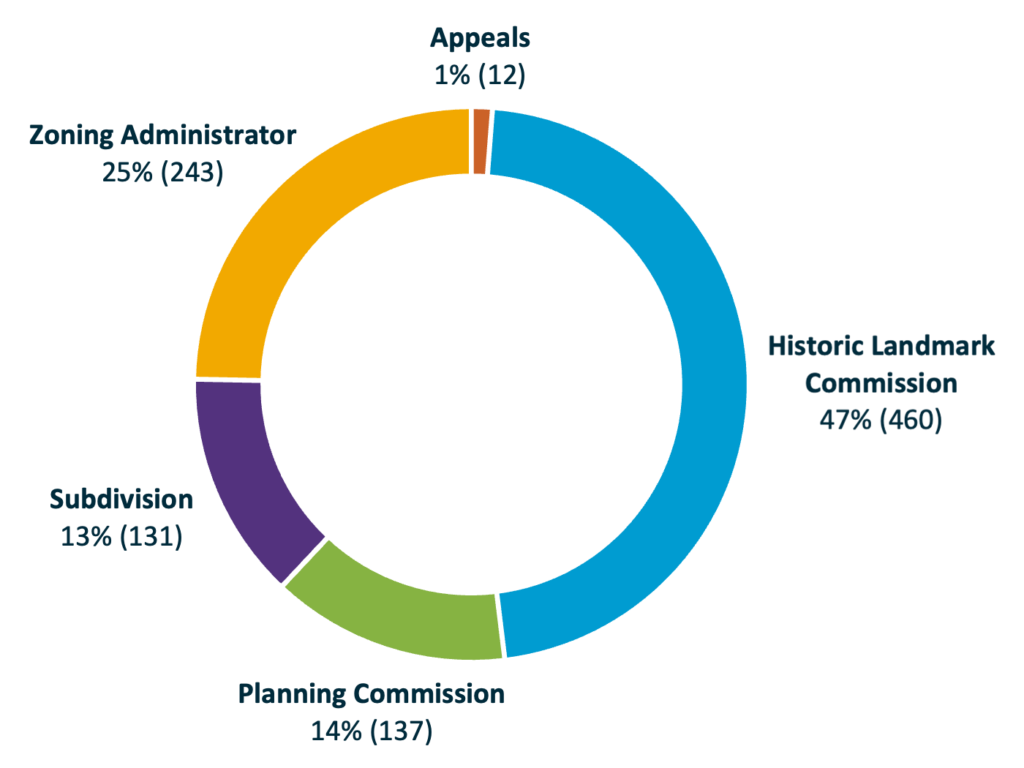
- Appeals: 1% (12)
- Historic Landmark Commission: 47% (460)
- Planning Commission: 14% (137)
- Subdivision: 13% (131)
- Zoning Administration: 25% (243)
Appeals
A total of 12 appeal applications were submitted in 2025, including 1 appeal of a decision made by the commissions, and 11 appeals of administrative decisions.
Proposals Reviewed by the Appeals Hearing Officer
Appeals of Commission Decisions
- Appeal of Time Extension Granted for Design Review Approval at Approximately 336 S 300 E
Appeals of Administrative Decisions
- Appeal of a Zoning Violation at approximately 1807 S 1900 E
- Variance Request for an Accessory Building in the Front Yard at Approximately 1087 S 1300 E
- Appeal of a COA Denial at Approximately 1425 E Havard Ave
- Variance Request for West Village at Approximately 936 S 400 W
- Appeal of a COA Denial at Approximately 722 S 700 E
- Variance Request at Approximately 871 W 400 N
- Variance Request at Approximately 1739 S Mohawk Way
- Variance Request at Approximately 1363 S 1300 E
- Appeal of a COA Denial at Approximately 610 E South Temple
- Appeal of an Administrative Interpretation at Approximately 58 E Hillside Ave
- Appeal of a COA Denial at Approximately 272 North I St
- Appeal of a Building Permit at Approximately 1072 S Bonneville Dr
- Variance Request for Fence Height at Approximately 852 S West Temple
Administrative Hearing
Proposals Reviewed by the Administrative Hearing Officer
- Conditional Use for Roof Mounted Antennas at Approximately 310 E 500 S
- Conditional Use for 120′ Communication Tower at Approximately 4820 W 700 S
Historic Landmark Commission
A total of 460 Historic Landmark Commission applications were submitted in 2025. This category includes all requests to modify properties designated as Local Historic Landmarks or located within a Local Historic District .
Breakdown of Submitted Applications
- Demolition of Contributing Building: 1
- Demolition of Non-Contributing Building: 2
- Designation: 6
- Major Alteration: 7
- Minor Alteration: 434
- New Construction: 3
- Reconstruction: 5
- Relocation: 2
Historic Landmark Commission
The HLC reviewed 23 agenda items in 2025, the agenda website was accessed 2,051 times, and HLC meeting recordings were viewed over 946 times on the Salt Lake City YouTube channel.
Planning Commission
A total of 137 Planning Commission applications were submitted in 2025. This category includes nine different request types, some of which are reviewed and approved administratively by staff.
Breakdown of Submitted Applications
- Alley Vacations: 10
- Conditional Use: 13
- Design Review: 19
- General Plan Amendment: 7
- Planned Development: 13
- Street Closure: 5
- Transit Station Development: 12
- Zoning Amendments: 27
- Zoning Incentives: 31
Planning Commission
The Planning Commission reviewed 83 agenda items in 2025, the agenda website was accessed 6,089 times, and PC meeting recordings were viewed over 3,559 times on the Salt Lake City YouTube channel.
Subdivisions
A total of 131 Subdivision applications were submitted in 2025. This category of applications includes 4 different request types.
Breakdown of Submitted Applications
- Consolidations: 34
- Final Plat Approvals: 39
- Lot Line Adjustments: 14
- Preliminary Subdivisions: 44
Zoning Administration
A total of 243 Zoning Administration applications were submitted in 2025. This category of applications includes 4 different request types.
Breakdown of Submitted Applications
- Administrative Interpretations: 12
- Determinations of Non-Conforming Use: 7
- Variances: 12
- Zoning Verification Letters: 212
Online Open Houses
In 2025, the division hosted 108 Online Open Houses, including 48 projects from previous years and 60 projects for 2025, with a total of 15,100 visits.
In early 2020, the Planning Division launched Online Open Houses, providing constituents with the opportunity to review projects and submit comments and questions without attending in-person events. These online open houses have attracted significantly higher traffic and engagement compared to traditional in-person events.
Accomplishments
Adopted the Mixed-Use Zoning Consolidation
In July 2025, the Salt Lake City Council adopted the Mixed-Use Zoning Consolidation. This proposal consolidated 26 existing commercial, form-based, and mixed-use zoning districts into six new Mixed-Use (MU) districts, reducing the zoning code by approximately 50 pages and streamlining the regulations. The changes are intended to promote a balanced mix of commercial and residential uses while encouraging neighborhood-oriented amenities.
The new MU districts establish a framework for context-appropriate building scale and design that enhances placemaking and supports walkability. In addition, the proposal incorporated strengthened building design standards to ensure that new development is attractive and contributes positively to the character of each mixed-use neighborhood.
Adopted the RMF-35 & RMF-45 Zoning Amendments
In November 2025, the Salt Lake City Council adopted amendments to the RMF-35 and RMF-45 multifamily zoning districts to encourage the development of more affordable and attainable housing while supporting residents in established moderate-density neighborhoods. The amendments are intended to better fulfill the purpose of these districts by facilitating moderate-density housing in a way that retains neighborhood character and preserves existing units.
Key changes include removing regulatory barriers to development, such as eliminating minimum lot width requirements and adjusting lot size standards, providing bonus units for the preservation of existing buildings, and incorporating building design standards.
Expanding Housing Options
Kicked off the Expanding Housing Options project, a citywide zoning text amendment affecting low-density neighborhoods. The proposal would add a new section establishing zoning standards for Small Lot Dwellings and make amendments to the R-1, R-2, SR-1, SR-1A, Flag Lot, Definitions, and Table of Uses sections in the zoning ordinance.
Northwest Community Plan Update
The Northwest Community Plan is a 15-year vision plan that will guide future development for the land located within its boundaries. The Northwest Community Plan follows the structure of Plan Salt Lake, with 14 guiding principles, with specific targets and initiatives to achieve the stated goals. The Northwest Community Plan includes three main elements: Existing Conditions Report, Draft Plan, and the Station Area Plan. The plan boundaries include the following neighborhoods: Jordan Meadows, Rose Park, Fairpark, Westpointe, and a small portion of Poplar Grove. The Northwest plan area also includes four station area plans for the Trax Stations along North Temple. Utah Code requires cities to adopt station area plans for each rail station that is within the city or within ½ mile of the city for stations outside the city boundaries.
Avenues & Capitol Hill Community Plan Updates
The Planning Division is working on updating the Avenues and Capitol Hill Community Plans. An existing conditions report was completed to evaluate current trends and alignment with adopted citywide plans, establishing a shared understanding of each area’s context. Building on this foundation, the team is working closely with community members and stakeholders to shape a 15-year vision with clear, measurable goals that reflect their priorities and values. The updated plans are anticipated to be finalized in 2026.
Growing Water Smart Plan Amendment
The Growing Water Smart Plan Amendment amended Plan Salt Lake to formally integrate the city’s land use plans with the City’s 2022 Water Supply and Demand Plan & Water Conservation Plan completed by Salt Lake City Department of Public Utilities. This amendment updated the city’s general plan to comply with Utah State Code 10-9a-403, which mandates the inclusion of a water element in Plan Salt Lake by December 31, 2025.
Miscellaneous Zoning Ordinance Updates
- Design Review Amendments
- Building Preservation Incentives Amendments
- Utah Wildland-Urban Interface Code
- Downtown Parking Regulations
- Parking Dimension and Off-Street Parking Manual Amendments.
Planning Staff advanced several zoning text amendments through the adoption process, each intended to align with State law, remove barriers to development, or clarify and streamline the zoning code. These updates amend Design Review standards to ensure development is appropriately scaled and contributes positively to the surrounding community; amend building preservation incentives to improve usability; incorporate Utah Wildland-Urban Interface requirements into code; and change to parking standards include allowing tandem parking for all land uses to support housing development.
Planned Development and Community Benefit Amendments
Planning Staff began drafting amendments to Chapter 21A.55 Planned Developments to require a community benefit for larger or more impactful Planned Development applications, particularly where a project requests significant waivers or modifications to zoning standards. The proposed changes would also apply to Planned Developments that result in the displacement of housing. In such cases, applicants may be required to provide tenant relocation assistance and replace any demolished units.
These requirements are intended to align with the existing community benefit and displacement standards for zoning map and text amendments. The proposed amendments will be released for public review in spring 2026.
Hosted the Utah American Planning Association Conference
The Salt Lake City Planning Division was proud to host the Utah APA Fall Conference, themed “Utah: The State of Planning.” Planning staff played a key role in developing a robust program of mobile tours and sessions. The event brought together planners, elected officials, planning commissioners, and community leaders on October 9–10 at The Gateway. Mayor Mendenhall opened the conference, followed by a keynote address from nationally recognized planner Mitchell Silver, FAICP, on “Planning with Purpose,” and the Annual Awards Ceremony.
The conference featured sessions on housing, transportation, historic preservation, water planning, ethics, urban design, and community engagement, including discussions on the Great Salt Lake, the future of the Smith’s Ballpark site, and Utah’s housing supply challenges. On the second day, Corrin Wendell, AICP, delivered a keynote on youth engagement in planning. Attendees participated in mobile tours of downtown Salt Lake City and Capitol Hill by bike and TRAX, and concluded the event with a neighborhood gathering in the Central 9th district. The conference provided an educational and community-focused experience for Utah’s planning professionals, while showcasing Salt Lake City’s planning work and projects.
Division Sessions & Tours
- Ballpark Next: Co-Creating a Human-Centered Design Framework for the Smith’s Ballpark Site
- Form-Based Code in the Real World: Led by Nick Norris and Michaela Bell
- Take Back the Streets: Re-Imagining Streets as Public Space, led by Jon Larsen and Blake Thomas
- Multifamily Infill and Adaptive Reuse in SLC Historic Districts: Led by Sara Javoronok, AICP and Lex Traughber
- Youth Voices, Real Choices: Engagement in Action, led by Meagan Booth
- The Everything Bagel Approach to Development Agreements: Led by Krissy Gilmore
- Downtown & Capitol Hill Bike Tour: Led by Andy Hulka, AICP and Keegan Galloro
- Growing a Walkable Urban Center in Sugar House: Led by Nick Norris and Jon Larsen
- Presentations at National APA: The Planning Division staff made presentations on implementing general plans and engaging the youth at the American Planning Association Annual Conference in Denver. At the National League of Cities conference, held in Salt Lake City in November, planning staff were part of a panel discussing overcoming regulatory barriers to address housing issues and led several mobile workshops. The mobile workshops covered zoning modifications to remove housing barriers, adaptive reuse, innovative housing projects, development around transit, and linking land use with transportation planning.