Salt Lake City Department of Public Utilities (SLCDPU) is installing a Biofilter at 1020 West Pierpont Avenue to implement odor control and protect underground sewer pipes. Over time, these gases have contributed to unpleasant smells and faster pipe deterioration. The Biofilter will safely remove them, improving conditions for the community and the sewer system.
What is the purpose of a Biofilter?
Hydrogen sulfide (H2S) gas forms naturally as waste breaks down in the sewer. Currently, this gas escapes through maintenance lids and causes strong odors. Hydrogen sulfide can also turn into sulfuric acid, which damages concrete sewer pipes. By filtering this gas, we are:
- Reducing odors in the immediate area
- Preventing pipe corrosion, which could lead to costly and disruptive emergency repairs.
How does it work?
The biofilter uses a biological process in which bacteria grow on a biomat (a plastic media), naturally breaking down sulfur compounds. The system is proven to remove up to 99.5% of hydrogen sulfide. We are also installing carbon filters to capture any remaining traces before air is released. The primary emissions from the process are nitrogen gas, oxygen, and water vapor.
What will the site look like?
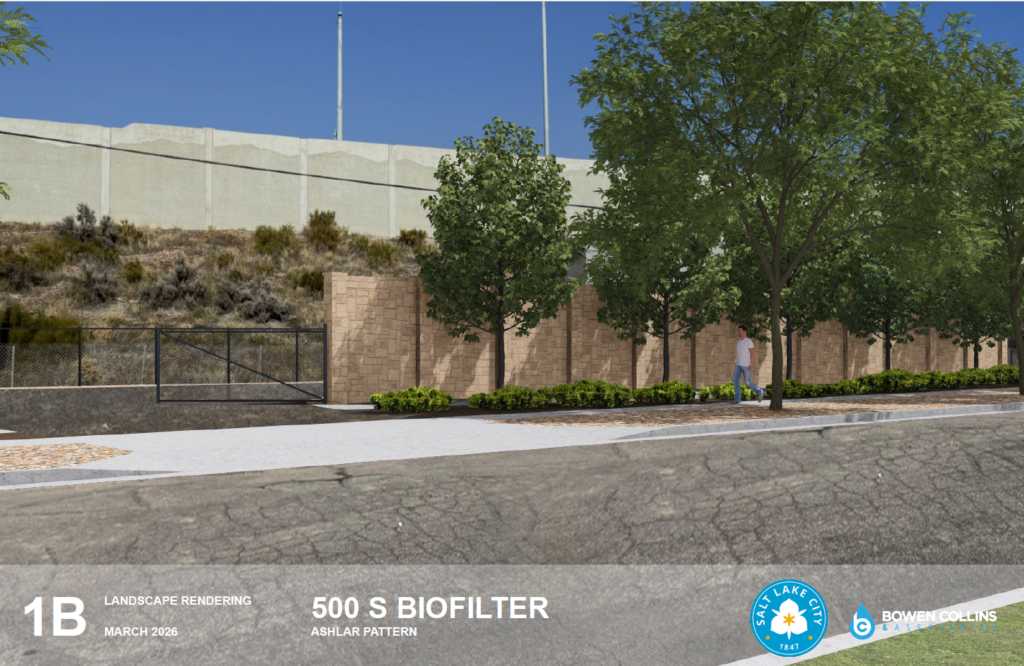
Based on community feedback, we have decided to remove the tower component of the facility. This change reduces the maximum height of the structure from approximately 30 feet to 15 feet. The modification will not impact the effectiveness of the odor control system. This change will not have any health impacts, as the primary emissions from the process are nitrogen gas, oxygen, and water vapor.
After construction, we will install water-wise landscaping, including a mix of trees, decorative rock, and gravel to help the facility blend into the environment.
Why this specific location?
After a thorough study, this site was selected because it’s near a major junction where a 66-inch trunk line converges with other pumped lines.
When these lines meet, the water becomes turbulent, releasing hydrogen sulfide. To remove odors, we need to filter the gas where it’s being released.
Schedule
Construction began in March 2026 and will conclude by Spring 2027.
Most site work will be completed by October 2026. Construction activity is anticipated to pause until the filter equipment is delivered in January 2027. Equipment start-up and testing is expected to wrap up by Spring 2027.
Project Timeline
- March – June 2026: Roadway and utilities work. Residents can expect to see significant activity as we prepare the connection to the 1200 West trunk line.
- June – October 2026: Sitework including site grading, concrete pours, and site landscaping.
- Spring 2027: Installation of biofilter, connection to utilities, finalize landscaping, and system testing and calibration.
Construction Impacts
- Construction activities Monday through Friday between 7am and 5pm.
- Occasional nighttime or weekend construction activities.
- Notification prior to any potential road closures or detours.
- Maintained vehicle access with brief interruptions. Trenches may be plated to provide vehicle access.
- Increased noise and dust should be expected.
Engagement Resources
- On-site neighborhood visit – Jan 5, 2026
- Community information meeting – Jan 15, 2026
- Presentation to Poplar Grove Community Council – Jan 28, 2026
- Advisory Group First Meeting – Feb 18, 2026
- Presentation to Poplar Grove Community Council – Feb 25, 2026
- Advisory Group Technical Meeting – Mar 5, 2026
- Presentation to Poplar Grove Community Council – Mar 25, 2026
- Flyer – mailed April 2025
- Presentation to Poplar Grove Community Council – April 23, 2025
- Advisory Group Landscape Meeting – March 30, 2026
Advisory Group
The project team has convened a Public Advisory Group made up of volunteer community members to help inform and advise key elements of the project.
This group provides valuable community perspectives to support project planning and design. Advisory Group members are currently working alongside the project team to develop a landscape plan for the site, which will be considered as part of the overall design process. This effort includes collaboration with our department’s Conservation Manager and a landscape architect from Bowen Collins, ensuring the plan reflects both technical requirements and community input.
In addition to design input, the Advisory Group has participated in a technical workshop focused on the project’s functionality, feasibility, and safety. During this session, members submitted questions and engaged directly with a panel of subject matter experts, including key project team members, to better understand how the biofilter will operate and how potential concerns are being addressed.
The Advisory Group will continue to serve as a valuable forum for dialogue and feedback as the project moves forward, helping the project team consider community perspectives alongside technical, regulatory, and operational factors.
What is the 500 South Biofilter Project? Salt Lake City is installing an odor control system near a major intersection of sewer lines. This project will reduce sewer odors and help protect sewer pipes from corrosion. The system will pull clean air into the sewer pipe, displacing and treating foul air before releasing it back into the atmosphere. Why is this project needed? When wastewater travels through sewer pipes, gases can form naturally. One of the most common is hydrogen sulfide, which smells like rotten eggs and can also cause corrosion in sewer pipes. The biofilter system will capture and treat these gases before they escape into the surrounding area. What is a biofilter? A biofilter is a natural odor‑treatment system that uses microorganisms (helpful bacteria) attached to a filter material to break down odor‑causing compounds in the air. As sewer air passes through the biofilter, these microorganisms convert odor‑causing gases into stable compounds that do not smell and are not harmful. What will the project accomplish? The biofilter system will reduce sewer odors, help protect sewer infrastructure from corrosion, improve overall system reliability, and treat sewer gases before they are released into the air. How does the biofilter system work? The system pulls air from the sewer through a fan. The air passes through two treatment steps: (1) a biofilter where microorganisms break down odor‑causing compounds and (2) an activated carbon filter that captures any remaining trace odors. After treatment, clean air is released back into the atmosphere. What compounds does the system treat? The system is primarily designed to treat hydrogen sulfide (H₂S), the gas most responsible for sewer odors and corrosion. It can also reduce other sulfur‑based odor compounds that may be present in sewer gas. The activated carbon filter is capable of removing a wide variety of pollutants that can occur in sewer systems. Will the system treat methane? No. Methane may be present in sewer systems but usually at very low concentrations. Methane is not a major contributor to sewer odor or corrosion, so the biofilter is not designed to treat it. The City monitors methane levels at wastewater facilities as part of normal safety procedures. Can the biofilter fail? The system is very reliable because it has few moving parts. If the fan were to stop working, the system would temporarily stop pulling air from the sewer. In that case, conditions would return to what they are today—odors would not become worse than current conditions. What happens if the fan motor fails? If the fan stops working, air will remain inside the sewer system instead of being pulled through the biofilter. Sewer gases may vent through manholes and plumbing vents as they do today. The system would be repaired as part of normal operations and maintenance. What happens if hydrogen sulfide levels suddenly increase? The biofilter handles normal conditions while the activated carbon filter captures short‑term spikes in odor compounds. If higher levels continue for a longer period, the biological system naturally adapts by growing more microorganisms that break down the compounds. How will the system be monitored? City staff will regularly inspect the system and monitor hydrogen sulfide levels entering and leaving the treatment units. These measurements help confirm the system is working properly and determine when maintenance is needed. How often will the system be checked? During the initial startup period, the system will be checked weekly or more often. As operating data is collected, maintenance schedules will be adjusted accordingly. When will the activated carbon need to be replaced? Activated carbon is expected to last about one to two years, depending on odor levels and operating conditions. Replacement timing will be based on monitoring data. Why was this site chosen? The site was selected because it is close to a major sewer line intersection where odors can occur. The location also provides the space needed for equipment access and connections to water and power. Were other odor control options considered? Yes. The City evaluated several odor‑control technologies including chemical treatments and different filtration systems. A biofilter with additional carbon filtration was recommended because it is a reliable and widely used approach for wastewater systems. How much of the sewer system drains to this location? Salt Lake City’s sewer system is highly interconnected. Approximately 546 miles of upstream sewer lines could potentially convey wastewater to this part of the system. What industries discharge wastewater into the sewer system? A wide variety of industries discharge into the sewer system. The City operates a pretreatment program that regulates industrial discharges to the sewer system. Businesses and industries must meet strict requirements under federal, state, and local regulations before they can discharge wastewater. What are the hydrogen sulfide levels in the sewer at this location? Hydrogen sulfide concentrations measured in the pipe have averaged around 20 parts per million (ppm), with peak measurements up to 1,100 ppm. Will the biofilter produce sulfuric acid? What happens to it? During treatment, hydrogen sulfide is converted into small amounts of sulfuric acid. This liquid drains back into the sewer system where it becomes diluted and is eventually treated at the Water Reclamation Facility. Is air quality modeling required for this project? No modeling or air quality permitting is required because emissions are well below regulatory thresholds set by the Utah Division of Air Quality.Project Basics
How the System Works
Performance and Reliability
Monitoring and Maintenance
Project Design and Site Selection
Sewer System Questions
Technical Questions
For more information
To receive email updates about the project, send an email to [email protected] with “Updates” in the subject line. You can also reach the project team by calling 801-616-3336.