
FY27 Utility Rates
— Quick Links —
Salt Lake City’s Department of Public Utilities proposed rate increases for water, sewer, stormwater, and street lighting. These rates were approved by City Council and took effect July 1, 2026. View the FY 2027 budget.
What do utility rates pay for?
Salt Lake City Public Utilities provides safe, reliable drinking water; manages stormwater and wastewater to protect our rivers and the Great Salt Lake; and maintains street lighting for public safety. Your utility rates support the operation, maintenance, and replacement of the infrastructure that makes these services possible—from treatment plants and pipelines to water quality testing and system repairs.
Why are rates increasing?
Much of the infrastructure that supports these services is aging and nearing the end of its lifespan. Salt Lake City’s three drinking water treatment plants and one sewer treatment plant are more than 70 years old, and many are in need of repair or replacement.
Replacing and upgrading these systems is essential to maintaining safe, reliable service. At the same time, these are large, long-term investments that cannot all be completed at once without placing a significant burden on residents. So each year, the City carefully prioritizes projects—focusing first on the most critical needs—while working to balance necessary improvements with affordability. This approach helps ensure we continue to provide reliable service today while planning responsibly for the future.
— On this Page —
How to Use the Rate Calculator
This tool gives you an idea of your proposed water and sewer costs. It’s meant to help you get a general idea of your bill, but the estimate will not be exact. Keep in mind, this calculator only estimates water and sewer charges. It does not include fixed fees for garbage, street lighting, and stormwater. For more specific information, please view the proposed budget.
To get the best estimate you must know:
- Which service you want to estimate (water, sewer, or both)
- Your service line size (most single-family homes have 3/4″)
- The size can be found in the upper left-hand portion of your bill: look for water service fee and the line size will be listed.
- Your typical monthly water use (look at a past bill)
- Basic details about your home like residential or multi-family, and whether you’re in Salt Lake City or reside in our water service area outside of Salt Lake City boundaries (Millcreek, Holladay, Cottonwood Heights, etc.)
Water Rates
Water rates are increasing to keep the City’s drinking water system safe, reliable, and ready for the future. Much of the system, including drinking water treatment facilities and more than 1,000 miles of pipe, is aging and needs repair, upgrades, or replacement to keep delivering high-quality water to homes and businesses.
At the same time, the cost of this work has increased due to higher construction and equipment costs, new regulatory requirements, and updated health and safety requirements. These investments help the system work as it should today and prepare for future needs.
County rates: Salt Lake City’s drinking water service area includes communities located outside Salt Lake City’s municipal boundaries. Water rates for customers in these communities are 35% more than water rates for customers within Salt Lake City’s boundaries. This is because residents and businesses within Salt Lake City pay Metropolitan Water District of Salt Lake and Sandy (MWDSLS) taxes and cover risk liabilities, while customers outside Salt Lake City do not pay taxes or are subject to risk related liabilities. The MWDSLS taxes and risk costs paid by Salt Lake City residents provide critical benefits to customers outside of Salt Lake City. The higher water rates for customers outside Salt Lake City ensure everyone pays their fair share of water and operational costs.
The following examples are based on City rates. County water rates are 35% higher than City rates. These examples will not match every household. Your actual bill depends on your specific usage and service details. For the most accurate estimate, use the rate calculator.

Residential (single-family, duplex, triplex)
One CCF is one hundred cubic feet of water, which is approximately 748 gallons of water. There is also a service fee included based on water meter size.
Minimum Use (~6 CCF)
Indoor use with little or no outdoor use
2026: $40.71 → 2027: $53.90
Estimated monthly increase: +$13.19
Low Use (~8 CCF)
Indoor use with minimal outdoor use
2026: $47.15 → 2027: $61.52
Estimated monthly increase: +$14.37
Medium Use (~21 CCF)
Indoor and outdoor use
2026: $104.77 → 2027: $129.72
Estimated monthly increase: +$24.96
High Use (~61 CCF)
Indoor use with significant outdoor use
2026: $304.16 → 2027: $367.19
Estimated monthly increase: +$63.00
Multi-family Rates
Summer rates (April – October) are $3.97 per CCF, and winter rates (November – March) are $2.58 per CCF. There is also a service fee included based on water meter size.
Commercial, Industrial, and Institutional Rates
Summer rates (April – October) are $4.18 per CCF, and winter rates (November – March) are $2.58 per CCF. There is also a service fee included based on water meter size.
What do water rates cover?
These charges cover clean water delivered to your home or business for everyday use, such as cooking, cleaning, and watering outdoors. Rate changes will look different for everyone. Your costs depend on a few key things:
- The size of your service line
- How much water you use each month
- Customer type (residential, commercial, or industrial)
Each service includes multiple charges. These charges are usually a fixed monthly fee and a usage-based fee.
- Monthly service fee (fixed): A set charge each month based on your meter size. This helps cover the cost of maintaining the system and delivering safe, reliable drinking water.
- Usage rates (based on use): Water is priced in “blocks,” also referred to as “tiered pricing.” The more water you use, the higher the cost per unit. Lower use is cheaper; higher use costs more. This is to encourage water conservation and account for the higher cost of water service during peak usage months.
Sewer Rates
Sewer rates are going up to pay for the replacement of the City’s 65-year-old sewer treatment plant to meet new water quality requirements and to replace aging infrastructure. The City also faces higher labor and material costs, as well as stricter environmental regulations that require upgrades to protect water quality. These rate increases help ensure the sewer system remains reliable, meets regulatory requirements, and continues serving the community into the future.
These examples are meant to give a general idea of how rates may change. They will not match every household. Your actual bill depends on your specific usage and service details. For the most accurate estimate, use the rate calculator.
Residential (single-family, duplex, triplex)
The rates consist of a fixed monthly fee and a flow charge based on average winter water consumption.
Minimum Use (~2 CCF)
Lower than average indoor use
2026: $20.82 → 2027: $29.26
Estimated monthly increase: +$8.44
Low Use (~4 CCF)
Average indoor use
2026: $37.94 → 2027: $48.94
Estimated monthly increase: +$11.00
Medium Use (~8 CCF)
Slightly above average indoor use
2026: $72.18 → 2027: $88.30
Estimated monthly increase: +$16.12
High Use (~15 CCF)
Much greater than average indoor use and may be a symptom of indoor leaks
2026: $132.10 → 2027: $157.18
Estimated monthly increase: +$25.08
Multi-family Rates
The multi-family rate structure has changed to a fixed fee per dwelling unit, instead of a flow charge. The rate is $48.94 per dwelling unit.
Commercial, Industrial, and Institutional Rates
These rates consist of a fixed monthly fee and a flow charge. The fixed monthly fee is $9.58 per ERU (Equivalent Residential Unit). One ERU is equal to four CCF of an average monthly flow. The flow charge is $10.97 per CCF which is based on 70% of total water consumption.
What do sewer rates cover?
These charges are for wastewater that leaves your home or business through drains and toilets and is treated before being returned to the Great Salt Lake. Rate changes will look different for everyone. Your costs depend on a few key things:
- How much water was used over the winter months
- Customer type (residential, multi-family, or commercial)
Each service includes multiple charges. These charges are usually a fixed monthly fee and a usage-based fee.
- Monthly fee (fixed): A set charge each month that helps cover the cost of moving wastewater from your home to treatment plants.
- Usage rate/flow charge (based on use): A charge based on how much water you use. This helps cover the cost of treating and disposing of wastewater.
- Winter average (used to estimate usage): For single-family homes, duplexes, and triplexes, sewer charges are based on your average winter water use. This helps estimate indoor use.
Stormwater Rates
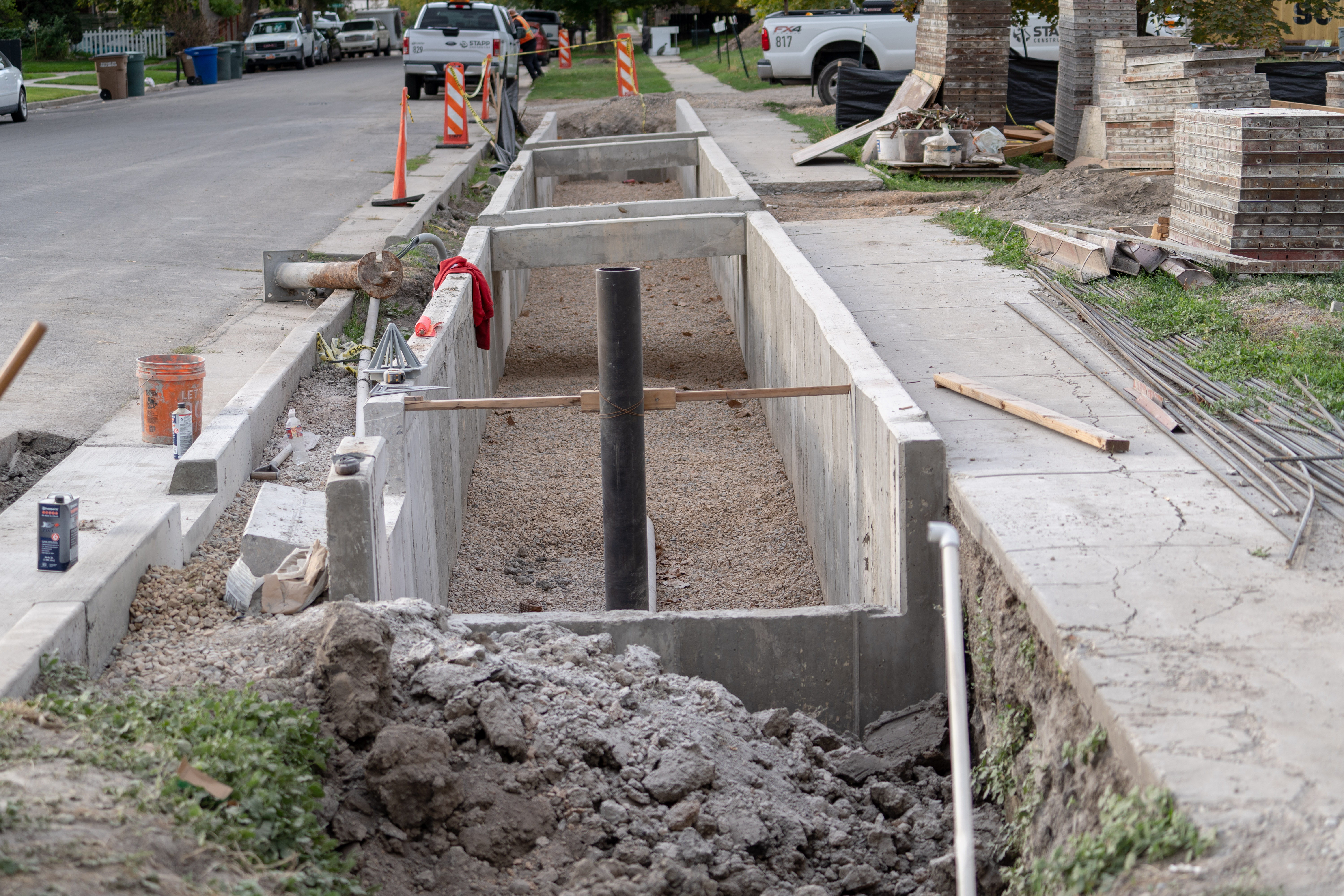
Stormwater rates are increasing to repair and replace older pipes, drains, and other parts of the system that are wearing out. The increase also helps keep the system working reliably, meet environmental requirements, and cover rising costs fairly.
Stormwater rates are more consistent than water rates and are not based on monthly usage. Your cost is based on your property type and size, using a standard unit called an ERU (Equivalent Residential Unit) that reflects the amount of runoff your property generates.
All customers fall into a set category, so monthly costs are predictable.
Single & Duplex (less than 0.25 acre)
Smaller residential property
2026: $8.75 → 2027: $10.50
Estimated monthly increase: +$1.75
Single & Duplex (more than 0.25 acre)
Larger residential property
2026: $12.25 → 2027: $14.70
Estimated monthly increase: +$2.45
Triplex & Fourplex
Multi-unit residential property
2026: $17.50 → 2027: $21.00
Estimated monthly increase: +$3.50
Multi-family and Non-residential
Based on property size (per ERU)
2026: $8.75 → 2027: $10.50 (per ERU)
Estimated monthly increase: +$1.75 per ERU
What do stormwater rates cover?
This fixed fee pays for the system that carries rain and snowmelt from streets, roofs, and yards into drains to help prevent flooding and protect water quality in our waterways. Fees also help support drainage systems and water-quality protection measures that protect downstream aquatic environments.
Street Lighting Rates
Residential and commercial customers support street lighting through a fixed monthly user fee. Street lighting rates are increasing to pay for rising maintenance and infrastructure costs needed to keep the system reliable and safe. The City maintains more than 16,000 street lights, and copper wire theft has impacted costs.
Residential and commercial customers pay for street lighting. For homes, this is a standard base rate charge. For businesses, the fee is based on street frontage, and about every 75 feet is counted as one residential equivalent (ERU).

Majority of our residential customers
Residential Customers
2026: $5.19 → 2027: $7.79
Estimated monthly increase: +$2.60
Residential – Group 1 Rates
Residential areas of Rose Park with specific “Rose Park” light poles.
2026: $7.89 → 2027: $11.84
Estimated monthly increase: +$3.95
Residential – Group 2 Rates
Residential areas with enhanced decorative lighting in the Harvard/Yale neighborhood and also areas of the Avenues, Federal Heights, and East Bench.
2026: $22.17→ 2027: $33.26
Estimated monthly increase: +$11.09
Commercial District Lighting – Group 3
Downtown and commercial district areas of the city with enhanced lighting
2026: $60.97 → 2027: $91.46
Estimated monthly increase: +$30.49
What do street lighting rates cover?
This fixed fee helps maintain a system that illuminates streets, sidewalks, and public areas to help people travel safely at night.
Frequently Asked Questions
Why do customers’ bills increase each year? Why now? We are upgrading aging water, sewer, and stormwater infrastructure to prevent failures. Much of the system is over a century old. Three water treatment plants from the 1950s are also nearing the end of their useful life. One is currently being replaced, with the other two planned within ten years. We are also completing the replacement of the City’s only sewer treatment plant this year to meet new regulatory requirements at a cost of nearly a billion dollars. Due to the scale and cost of these projects, rate increases are necessary to fund current and future improvements.
How is the money I pay for my Public Utilities bill used? These rate increases help ensure clean, reliable water service now and into the future. Much of our water, sewer, and stormwater infrastructure is aging and requires ongoing investment to remain safe and dependable. Our street lighting system, which supports pedestrian safety at crossings and provides a secure night-time environment, also needs regular updates and repairs. For example, we are replacing old lead water service lines across the service area over the next several years. This effort protects public health while addressing aging infrastructure. In addition, some sewer lines date back to the 1890s, making their repair and replacement a top priority in this year’s budget.
See more frequently asked questions
What is infrastructure? Infrastructure includes all of the facilities that have to work to bring clean drinking water to your tap and clean up sewage so that clean water is discharged to Great Salt Lake. This includes dams, reservoirs, treatment plants, pipelines, pump stations, storm drains, watersheds, and riparian corridors. There is a massive amount of infrastructure that needs to be in place and working, in order to protect the health and environment for hundreds of thousands of people.
How does water conservation affect my water rates? Water conservation does not significantly reduce the cost of providing service. Most utility expenses come from maintaining infrastructure, meeting regulatory requirements, and ensuring safe drinking water and proper wastewater treatment. These costs remain largely unchanged regardless of usage levels. However, conservation is still critical. It helps extend water supplies during drought and population growth, and it supports the health of Great Salt Lake. Over the long term, conserving water can also reduce or delay the need for costly new water sources and expanded infrastructure, strengthening overall water security. Public Utilities offers a variety of conservation resources to help you conserve water.
What if someone cannot afford the rate increases? If you’re having trouble paying your bill, there are resources available to help. We partner with local organizations to help qualifying residents, and staff can help connect you to those programs. We also participate in Salt Lake County’s tax abatement program for water, sewer, and stormwater. Our Project Water ASSIST program helps customers who are at risk of disconnection. The best first step is to contact Public Utilities directly. Staff can walk through your situation and connect you to available resources. Customer Service can be reached by calling (801) 483-6900.
How are rate adjustments helping meet regulatory compliance? How much money goes into meeting requirements? Are there new requirements since last year that have to be funded? The primary driver of costs is maintaining and replacing aging infrastructure and ensuring that our operations meet regulatory compliance requirements for drinking water, stormwater, and sewage. Regulatory compliance means that the water you drink does not contain contaminants (over 90 of them) that are regulated by the United States Environmental Protection Agency and State of Utah. It also means that sanitary sewer lines do not overflow into the environment so that the treated wastewater is free from pollution before it goes to Great Salt Lake. Much of the system was built many decades ago and requires ongoing investment to keep service safe and reliable. The replacement of our sewer treatment plant is directly a result of meeting new regulations that reduce the number of pollutants that can cause harmful algal blooms. At the same time, we must meet strict state and federal standards, which require continued testing, treatment, and system upgrades.
How are we being transparent about rates, costs, and spending? The City’s budget process is designed to be transparent and accessible. Budgets are shared publicly, discussed in open meetings, and reviewed by elected officials. This gives residents the opportunity to see how rates are used and provide input before decisions are made.
Are rates setup equitably? How are high-water users being held accountable in this system? Salt Lake City uses block pricing (also referred to as tiered pricing) system for residential customers to keep costs lower for basic indoor water usage and encourage water conservation at higher usage levels. Using less water keeps households in lower-cost blocks, while using more water moves them into higher-cost blocks, which charge slightly more per gallon. This structure rewards smart water use and helps protect our long-term water resources. The cost of service is also higher during peak demand season in the summer when more water is used outside.
How many miles of water and sewer pipes, and stormwater infrastructure do you maintain? Salt Lake City maintains more than 13-hundred miles of water pipeline. In fact, if our pipes were all laid out in a line, they would reach St. Louis, Missouri! To maintain that much pipeline and ensure the quality of the water it carries, we conduct over 16,000 tests each month for 90 different contaminants. We also maintain nearly 700 miles of sewer pipe, and more than 360 miles of stormwater infrastructure.
Are ratepayers paying for new development? No. Developers pay connection fees and must cover the cost of any new or upgraded infrastructure needed for their projects. Each development is reviewed to ensure existing systems are protected.
How does Public Utilities operate financially? Public Utilities is an enterprise fund. User fees for water, sewer, stormwater, and street lighting cover operation, maintenance, and capital costs. We do not collect tax money.